
Media Conversions

I’ve been fretting for a while now about what to do about the collection of family related media I have – this would be slides, negatives, video, audio and prints. Of course, I’m not the only person to be thinking about this – David Pogue whom I enjoy reading, and who writes for the New York Times has written on this topic at least a couple of times recently as have many others. I suppose that there are at least two schools of thought to which you can subscribe: you can view all of your accumulated media history as being of interest only to yourself, and so it should all be tossed in the bin when you pass on, or you can take more of an archivists approach and try to collect and pass it along for the potential interest of future generations. When it was all paper this was simple – these days it isn’t quite as easy.

Two things happened recently that drove this home for me personally. I have become the keeper of my wife’s parent’s photo collection since they passed away, and so I’d like to catalogue it before all family memory fades as to the who, when and where the photos are of, and then when I recently checked back through my own collection for a photo of a motor bike I used to have, I found that the image was so faded I could no longer make out if it was a motorcycle or a bicycle ! My 8mm video tapes are just over 20 years old and as other’s have noted, finding a way to easily play them back has become more difficult of late, as new devices that are able to read the format have become few and far between. My understanding is that 8mm video record/play devices will soon no longer be available at all, so its fortunate that I don’t actually have a lot of tape to worry about – just a half dozen or so.  I’ve decided to get serious and do something.

The ‘something’ in itself is a bit of a problem – while you can contract out scanning etc., the effort and consequent cost really is in the cataloguing and sorting. And then, how do you store it ? Put all of this onto a computer hard drive, and when it crashes – as it will eventually – it’s all gone for good. CD’s and DVD’s are not really an assured storage medium and who’s to say you’d still have a device that will read them anyway in 10 to 20 years ? How many computers do you see today that still have 3 1/2 inch stiffy disks ? Or better still, 5 1/4 inch floppy’s ? Leaving the material on a hard drive should allow you to be able to copy the files easily from one media to another, but as I found out the hard way you can’t count on this working properly either as file corruption during transfers is a common issue with Windows systems. And if you do manage to get good copies on some sort of playable media – who will know who or what it is in 20 years time ? This whole area of data storage, migration and conversion David Pogue calls ‘data rot’ which I think sums it up nicely.

For my video’s then, what I’ve done is just transfer them directly to digital form and saved the raw footage ‘as is’ on our home server for the moment. This was a journey in itself, which took me some time to sort out – nothing is ever easy. I have an ATI TV tuner card in my XP PC, and it has a few input options that I can hook up the output off my 8mm camera to – the software that comes with the ATI card however is useless, so I decided to try an open source solution called Media Portal which I like to use for television watching and recording on the PC. The thing is, the format Media Portal saves in is ‘.ts’ which is a wrapper for standard .mpeg. When I went to edit these I found a couple of problems – the first being finding an easy to use editor as I had several applications that played back the ‘.ts’ files just fine, but had nothing to edit them. I tried converting the files into an .avi or standard .mpg format, and then found that I had all sorts of audio synchronisation problems. I wasn’t about to go out and buy a Mac (which would have just introduced a load of other problems, but does do this sort of thing quite well), and so in the end I gave up and looked elsewhere. I happened to have a Hauppauge WinTV-HVR 950 USB connected TV tuner, and thankfully it worked right out of the box when connected to my XP machine (but not any of my Linux boxes) and I was then easily able to save files from the camera in .mpg format which I could then edit using Nero Vision 5. I did try using Windows Movie Maker, but the version I had would only save in Windows formats and when I tried to convert those I again had audio/video synchronisation problems as well as video quality issues. I don’t especially like the Nero products as I find they usually crash a lot, often just as you finish working for several hours with a large file, but this time around it worked OK for a change.

After a week of wallowing about, I had fully converted all our home family video tapes and I was happy with the results – now what to do with them ? For the moment, I have the 66 GB of files, saved  on to two different hard disks. While I have thought about uploading them to my Amazon S3 storage, I suspect the upload time will take too long. While Shaw (my internet provider here in Calgary) tell me they don’t throttle uploads and downloads I think they are being less than truthful, as I have many times noticed that uploads and downloads start to transfer quickly and then progressively (regressively ?) slow down till they are practically crawling and you can almost see the bits as they are being transferred. I think instead that I will edit the video down to two or three director’s cut versions, with lots of text in them to give the who, what where and when information, and just ensure I have my usual three copies in three places (external hard disk in our safety deposit box, on the household server and on an external drive I keep in the house).

On to photos next time ……..

Posted in Personal, Tech | Tagged , , , , , , , | Leave a comment

1973 GT750 – Sods and Odds

Still plugging away at different bits and pieces of the 1973 GT750 project bike – I was side tracked with doing some video conversions from some twenty year old 8mm video tapes I had that I wanted saved to hard drive, and as well I’ve been playing with Windows Vista in preparation for the arrival of a new EPSON V700 scanner – but more on that later.

It seems hard to believe that it was August of last year that I first cracked the cases on the 1973 GT750 project bike engine, and discovered that things were a bit of a mess ! Just to recap, since then the frame and other bits and pieces were powder coated, the barrels had new threads inserted and the gauges have been rebuilt. I have a load of items in to be re-chromed which shold arrive back by month end. The crankshaft was rebuilt by Greg Miguez at his shop Greg’s Cycle here in Calgary, and the barrels have been bored to first over by Joe Haseloh at RPM Services in De Winton which is just south of Calgary.  I have been slowly sorting out parts and bits – keeping or repairing what I can and picking up new or NOS parts when I have found them. The good part is that as there is no deadline, I haven’t really felt pressured to get it finished, but that is also bad news. As is true of most people, without some sort of deadline I find that not too much happens ! Of late, the days have been getting longer, and we have had a few above zero days so I suppose that spring may actually be arriving yet again, and I’d like to be riding this bike once the warm weather gets here. Bottom line then is  I do need to pick up the pace  !

One thing I wanted to do was modify the upper engine case to include a small change to make future water pump cartridge removal easier, if it should be required.  This modification was first proposed by Allan Tucker on the Sundial GT750 board with input and tweaking from several board members. This and other removal tips are available at this link. What happens is that over time, the GT750 water pump cartridge gets seized into its enclosure, and if you then need to replace a seal or o-ring, you have to remove the engine from the frame and split the cases to get at the top of the water pump shaft so you can tap it out of the case. With this simple modification, all that’s required is to remove a small grub screw and then you can insert a punch and tap the cartridge out of the case with the engine in the frame.

In the photo to the upper right (just ‘click’ for a larger image), the screw driver points to the location of the 6mm x .1.0 grub screw. You need something that will sit flush with the upper surface of the engine case otherwise the starter motor has clearance issues – and don’t forget the Loctite ! Detailed instructions about where to drill and tap the hole are on the Sundial board web site, and as well a copy of Allan’s instructions is available for download here (just right-click and select ‘Save Link As’). Of course, in my instance, as I had the engine apart, all I had to do was flip the case over and drill a hole up through the end where the upper water pump shaft bearing rides. I’ve included a photo of what this looks like to the left (again, at the end of the screw driver).

Hopefully I’ll never need to use this, but it is a handy trick to have up your sleeve !

The engine cases are pretty much ready to go now – cleaned up and painted. As well, I’ve also changed out a few of the engine studs, and naturally the first one just twisted off flush with the upper engine case. This caused me an additional half day’s effort to drill out the broken bit of stud,  and re-tap the bolt hole to just clean up the threads. Quite annoying ! The only reason I even touched them was that the barrel locator shoulders on the two outboard studs had either completely corroded away, or had never been there in the first place – looking at the photo to the right the shoulder on a new stud is clearly visible on the stud to the right of the photo. The one I removed and which I think may have originally had a locator shoulder is on the left, but really its just a guess. There was no sign at all on any of the studs of a shoulder, and as well per Joe at RPM who bored the barrels to first over for me, the barrels were worn slightly crookedly which makes me wonder if the locator shoulders were ever there at all.  No way to know now of course,  but following the re-bore the cylinder bores are now square to the bottom gasket surface, so presumably all will be well in the future now that the locator studs have been replaced.

Over the next few days I’ll get the engine rebuilt and then perhaps think about putting it back into the frame – I do still have some repair work to finish on the tank and fork ears before sending them out for paint so there are still lots of things to be done.

March 15th Update:

Some additional research reveals that in the 1972 and 1973 model years (J and K models) there were no locating shoulders on the cylinder studs and all eleven studs were the same part number (09108-10006) . The shouldered studs (part number 09108-10012) were introduced late in the 1974 L model year and fully implemented in the 1975 M series, in conjunction with other changes to the crankshaft and pistons as detailed in service bulletin GT-6.  In theory then, any engine after number 38060 should have the new style crankshaft, pistons and studs, so the reason I couldn’t find the shoulders on my 1973 engine, was because they were not there to be found !

Posted in Motorcycle | Tagged , , , , , | Leave a comment

The Dumb Way Round

KCCD2009 All rights reserved Tormod AmlienThere are many folks who have done round the world trips on motorbikes, ranging from the rich and famous to the sort of fellow you’d meet in the local bar. Ewan McGregor of Star Wars fame and his friend Charley Boorman are possibly the best known of those to recently accomplish this feat. They had a support van and staff at various points, but they were the guys in the saddles doing the hard slogs on their new, fully up to date BMW’s and covered about 32,000 kilometres (20,000 miles) along the way. They made a TV series and also produced a book of their adventures which was called ‘Long Way Round’ which has been very popular – almost a must read amongst the motorbike crowd.  At the other extreme are the two guys from Norway  who I suspect almost no-one other than friends and a few admirers have ever heard of, who are attempting to ride their two 70 year old motorbikes a hell of a lot further !

Tormod Amlien and Klaus Ulvestad, together with their two 1930’s Nimbus motorcycle sidecar outfits left Norway in April, 2009 for a trip of truly epic intent – to ride 70,000 kilometres (about 44,000 miles) travelling east from Norway around the world. They have tagged their effort the KCCD (which is short for ‘King Croesus Contempt for Death’) 2009 tour, and you can follow along with their exploits on their web and blog site here .

The first part of their journey has taken them through Europe, Russia, Mongolia, South Korea and into Canada and the US.  And keep in mind that unlike the McGregor/Boorman effort these guys have no support team following behind them in a van (which included a doctor),  no big name international equipment suppliers, they definitely do not have new fancy bikes,  or international media sponsorship – basically no real safety net at all. At this point they are in Vermont doing full rebuilds on the two bikes after driving in the dead of winter across the US – and for anyone who hasn’t tried it, that can be one heck of a bad news adventure in a car, never mind on an antique motorcycle ! They will be at the New York City International Motorcycle Show January 22 through 24th – if you are in the area, and admire dogged determination, then it would be worth checking out. The two travellers will be giving a slide show and talk where attendees can ” Learn from the best in class how bad planning, even worse execution, and low budget can be defeated by stubbornness and ignorance of common sense.” Should be a worth listening to ! If you want to help finance a bit of what I consider to be admirable, eccentric behaviour they do accept donations (see the lower part of this web page), and if you wish to, you can buy a tour t-shirt here. I’ve already got mine !

It is already an amazing story, and they still have 50% of the trip ahead of them  – if they ever decide to publish a book, then I know I’ll buy a copy as soon as an English version is available !

Posted in Motorcycle, Travel | Tagged , , , , | Leave a comment

Frame Differences – Who Really Cares ?

Probably no one cares, but what the heck  – winters are long up here and sometimes stuff like this helps to pass the time !

Late in 2009 I needed to do a bit of clean-up and pick which frame I was going to use for the 1973 GT750 project, and I noticed a funny thing – even though there is just one frame part number listed for 1973, there are actually a  surprising number of little differences between the physical build of the Suzuki frames over the 1972/1973 period. This will most probably make most reader’s eyes glaze over, but if you want something to read as an aid to getting to sleep faster, then read on – of course if you are a slightly manic old bike re-builder then perhaps this will be interesting – in either case, you’ve been warned !

For a really good over view of the GT750 model’s evolution you can look no further than Jarmo Haapmaki’s web site which is a gold mine of great information – however if you really want specific, detailed engineering information – information on very specific design differences to help you determine originality – you have to look elsewhere. The part manuals are a start, and there is only one part number listed for the GT750 1972/1973 model year frames. However when looking at several frames closely, there are various obvious differences, so the only really solid source of information is the actual frames themselves. Fortunately, the local Loyal Order of Water Buffaloes here in Calgary has a good choice of frames available to examine !

Here is what I’ve noticed so far – and while I suppose it could be specific to bikes sold in North America, I suspect these differences may apply to the global production. In some cases I’ve provided links to photos:

  • the engine mounting lugs on the lower, front frame cradles in early frame builds (late 1971/early 1972) have different fittings than on frames made up to perhaps March 1972 – they almost appear  cast
  • around July 1972 for what were to become 1973 model year bikes,  the right side driver’s foot-peg mount was changed from the single post notched design mounted on the rear brake pivot as used in 1972, to being a  single bolt footpeg mount fitting on the frame , while retaining the small ribbed rubber cover design used in 1972
  • the rear turn signal mounts were changed from a welded tube mounting to be a bracket (part 41640-33001). A further change was made sometime around October of 1972 and the side stand mount was changed from a two bolt mount to a three bolt mount.
    • early build 1973 model year bikes then are easy to pick out, as they had 2 bolt side stands – later in the model year production run they switched over to three bolt side stands – yes I know you can also check the serial numbers, but not everyone carries a list of serial numbers around with them all the time …..
  • 1973 also had two different styles of radiator side covers – while they appear to be the same externally having a chrome finish, on the inside the early production model mounting fittings are shorter than on later ones – early have the same height mounting post as used on the 1972 model covers which were painted, and the posts are about 4 mm (about an 1/8th inch) ‘taller’ by late in the 1973 model run. I’m going to have a set re-metallised later this year by an outfit in BC,  and happened across this while I was sorting through different sets trying to find good candidates to be re-done and noticed they were not all the same. I suspect the added length may have been added to allow a wider air gap for cooling, as several of the samples I have show signs of heat damage at the four corners where the plastic cover would have been closest to the metal radiator.

What’s the point ? Well if you are really interested in knowing whether your bike is original, and/or possibly rare then it is these little subtleties that are worth looking for – otherwise I guess they are just potential trivia questions to be debated after a few beers at your local club meet 🙂

Next – some bling !

Posted in Motorcycle | Tagged , , | Leave a comment

iMacs, iTouch, eeePC and O!PLay

Its been one of those weeks ! First of all, a friend asked for some help with their brand new iMac and their iTouch.  I can hear the Macomaniacs starting to rant in the background that if you buy a Mac you don’t need any help as they are so easy to use, so superior to a PC, so clever etc., etc., etc.  – of course, as most sensible people would expect, this is rubbish. I think the best that can be said about Mac’s, other than that they are gorgeous to look at,  is that they are just ‘different’ and have their own quirks and foibles like any other compute box you buy.

My friend had an older model G5 based iMac and it had the common problem of a flaky motherboard and video, which if you are lucky, and if you bitch loudly enough, your local Apple store will repair at no charge. This in fact was done for another friend of mine after the warranty had expired, and it was one of those ‘under the table’ acknowledgements by Apple that there was an inherent design flaw or use of substandard parts in the product line – go here for a do-it-yourself procedure if you were stonewalled by your dealer, and want to try to effect your own repair.

At any rate, the idea was to move the older, flakey G5 downstairs, and install the new Intel based machine in the den after first moving over all the account information and data. Apple has a nice little application used for migrating account data from one machine to another which is supposed to work over either a network or a firewire cable – so I took along one of my firewire cables and figured this would be a quick and easy process. Not true – turns out the G5 has the Firewire 400 interface, and the newer Intel based iMac uses the Firewire 800 interface – why it is both types of connector are not provided on the new models to ensure some backwards compatibility is beyond me, but this is at least consistent with how Apple does things. The next hurdle then, was to try to buy a 400/800 cable or an adapter – the BestBuy outlet the machine had been bought from cheerfully informed us they didn’t carry them, and didn’t expect to have them for perhaps another three months ! After a bit of phoning around I found one at (where else) the MacWorld store and $20 later we had a very small piece of plastic which was the adaptor required to connect a firewire 400 cable to an 800 port.  Thankfully it worked, and after an hour or so the new machine was ready to go, although two small hiccups were noticed. For some reason, the personalised screen wallpaper had not been installed. This took me just a minute or two to fix. And the other was that as we had powered up the new machine and answered a few questions before transferring over the account information, we had to change the name of the main account to keep the transfer software happy. The iTouch connection initially was a bit confusing as we didn’t want to have to re-buy the applications already on the device and it was not immediately obvious how to synchronise with iTunes without erasing and starting over. After a bit of searching this was sorted out and everything seemed happy. The only thing I’m still not 100% sure of is the networking on the new machine – it seems to drop the connection occasionally to the D-Link router. It’s on a wired connection, and the G5 box, the iTouch, as well as other devices are rock solid on the same router,  so at the moment it seems to be just an issue with the new Intel based iMac. For the moment, I’ve decided to leave it be till we see if it really is a problem or possibly fixes itself as a result of an eventual software update.

I previously wrote about my eeePC here, and we still use it whenever we travel – as an early example of the form factor that came to be known as a ‘netbook’ it’s still great ! Unfortunately, Asustek isn’t adequately supporting the non-Windows versions running the the modified Xandros Linux OS, and frankly the stock implementation out of the box, while OK to use, and does what it needs to do, I find is just a bit too crippled in its functionality. Of course, when the eeePC was first released it was immediately hacked, and there are many sites offering ‘how-to’ information – my preferred one is located here. If you do a quick Google search, you can find many alternate versions of operating system tailored for the eeePC hardware. It has proven to be a very versatile platform for people to play with so, I thought I’d try out another OS’ just for a change – after looking at both Easy Peasy and eeebuntu, both of which appear to be excellent, I’ve decided to try out eeebuntu 3.0 Standard first and live with it for a few months, and then perhaps upgrade to their new EB4.0 release.

Version 3.0 of eeebuntu is a very complete, well packaged OS – all the things you normally use in the desktop/laptop Ubuntu environment are here, but it is optimised for the eeePC. I ran a live CD version for a few days just to play with it, and other than not liking the Banshee music player bundled with the applications software, it is pretty slick. Of course the first thing I did was a disc image backup of the Xandros OS already installed on my eeePC – the instructions on an easy way to do this are located here, and I used an 8 GB USB drive as the backup media. Once I had decided to take the plunge, eeebuntu 3.0 installed from the live CD with no drama’s at all, and it works like a charm. So far so good – I’ll let you know what I think after I’ve tried it for a couple of months.

The other thing I’ve been playing with this week is a new media player that connects into your home network, and allows you to easily and painlessly display your photos and saved TV shows on your TV, as well as play your centrally saved music files. There are several of these on the market, but the one I ended up buying is the Asus O!Play Air, which has wireless support built-in. This thing is a little sweetheart, about the size of a cigar box (if anyone can remember what those looked like !!) and has connections for composite video, audio, digital audio, HDMI, ethernet (wired and wireless), USB, eSATA, and multiple storage card formats (SD/MMC, CF and MS). It’s great ! I had no trouble at all getting it up and running, connected to my home server and displaying photos of our darling children on the TV, as a means to justify to SWMBO’d that this was a useful purchase ! It has built-in support for a wide range of video formats (MPEG1/2/4, H.264, VC-1, and RM/RMVB and lots of packages including .mp4, .mov, .avi, .divx, and .mkv etc.) – so far I haven’t found anything it won’t play but no doubt there are at least a couple. As the device is upgradable, I’d like to think that as new file formats appear, Asustek will provide updates to the O!Play, although at the price point this represents and given there is no internal data storage (and so no real data investment), it is almost disposable. The interface is a bit clunky – but I’m OK with clunky that works, so this one gets a thumbs up !

Posted in Tech | Tagged , , , , | Leave a comment

Re-Gauged !

The gauges to fit my 1973 GT750 arrived this week from Barbados, where they were rebuilt by a friend of mine, Allan Tucker. He operates a small Suzuki gauge repair business from his home there, and he is passionate about his hobby. I had planned to refurbish the gauges myself, but had seen his work and thought it would be just one less thing for me to have to worry about – plus knowing what a obsessive perfectionist he is, I was reasonably certain they would turn out better than if I tried to do them myself ! Looking at the results, I’d say I made the right call, as they do look virtually brand new !

Here are a couple of ‘before’ photos – as you can see the gauges looked pretty tired.

And here is how they look now !

I supplied  Allan with new glass lenses which were made for me by Ron Walder, owner of The Glass Guild here in Calgary. He and I met at an antique auto-restoration work shop put on by the Reynolds Museum in Wetaskiwin. The new lenses fit perfectly, and really dress up the look of the refurbished gauges ! Also, as a part of the refurbishment process, Allan  checks the calibration of the gauges and adjusts the mechanism as required to ensure they read as accurately as possible, so in that respect they are probably better than new as from the factory, Suzuki gauges really were not too accurate above about 60 mph !

Of course I now have a small problem – somehow I need to bring the rest of the bike up to the quality of finish of the gauges, otherwise they will make the rest of the bike look bad ! It is a nice problem to have ….

Posted in Motorcycle | Tagged , , , , , , , | Leave a comment

New Threads !

A common problem with early 1970’s Suzuki’s is having the exhaust bolt thread strip that hold the exhaust flanges (and therefore the exhaust pipes) to the cylinder head. This is due to the soft aluminium alloy just wearing away over time with the repeated removal and installation of the exhaust pipes for cleaning or maintenance. An option to avoid this wear is to install studs to replace the bolts, and I know a few folks who have done that on their bikes, but I prefer the factory look. Being stripped is bad, but making it worse is that often what will happen once the original thread is gone, owners will open up the hole to the next bolt  size (10×1.25mm) and just put in a larger bolt. Of course, once that one strips – and it’s just a matter of time – then you are truly stuffed. In the past, your only real option at this point would have been to find someone who could TIG weld more metal back in, and then drill and tap a new threaded hole and to do this would generally require the engine be removed from the frame as the working space is quite limited.

For the ‘first time’ failure mode, installing a Heli-coil thread repair insert is generally what most shops will do – this is usually an easy, quick, long-lasting, relatively low-cost solution if you are lucky – the ‘luck’ part mostly has to do with whether you can access the thread to do the install without having to pull the engine – in some cases on a motorcycle it just isn’t possible.. The inserts themselves are about $1 each (in the US), and are made of a hard stainless steel wire which has been coiled into a spring, and which you just thread into a re-tapped hole.
But what about the case where the hole has already been opened up to a larger size and has now been stripped again ? Or for that matter is a stripped Heli-coil ? I suspect you have a better chance of winning the lottery, but I seem to be blessed with bad luck when it comes to exhaust bolts so I’ve included this as a possibility. For this issue TIG has been pretty much the only option – till the folks at Time-Sert came up with their Big-Sert product line. These are oversize thread inserts – plugs actually – and are really clever, but also more expensive than Heli-coils. Of course, if your other only option is to pay for someone to do some speciality aluminium welding, then it starts to look like a bargain !

In preparation for having my 1973 GT750 cylinders re-bored and bead blasted, I decided to first tidy up the exhaust ports which had a couple of stripped threads – one was suitable for a Heli-coil repair as it was just a damaged 8×1.25 mm thread and so fairly small. The second one was a small crater of a hole that you could almost drop a 10mm bolt through without it touching, so I decided to try the Big-Sert and see how well it worked. Ten minutes later, as can be seen in the lower right of the photo, I had a brand new, very nice looking 8×1.25 mm threaded hole and was very pleased with the result ! The inserts are available in various lengths – for this size of bolt between 8 and 20 mm in-depth. I had the ‘stock’ length ones of 11.7 mm, as well as some longer ones at 16.2 mm, and opted to install the longer ones just to give more contact area on the bolt given it was after all an exhaust port being used to secure the exhaust pipe, and so subject to extremes of temperature and vibration.

As with Heli-coils, you typically buy a kit for each size of thread you are repairing. The Big-Sert kits contain all the bits and pieces you need to do the installation: drill bit, tap, reamer, install tool and inserts (of course you have to supply your own electric drill and tap handles). Unlike Heli-coils, Big-Serts are threaded plugs with a cam-lock built-in to stop the insert from moving once in place.  It’s a nice design and ideal for this sort of repair – but they are about twice the price of Heli-coils (if you shop around). I bought mine from ToolsQwik in the US – very helpful and easy to deal with, good prices and fast delivery. After including the postage cost, and currency exchange (there is no duty charged to bring these into Canada – just GST which you’d have to pay anyway), I still saved about 30% over what I was quoted for the same items here in Calgary, so as always it does pay to shop around.

I will be dropping the cylinders off at a shop south of Calgary in High River called RPM Services next week after Christmas, to be bored to first over size. I already have the pistons, rings, gudgeon pins etc., so it now looks like I will be starting to re-assemble the engine sometime in January. In the meantime, I still have to finish the wiring on the GT750 and sort out the fuel tank and a few other odds and ends on the GT500 I’m also working on, so I’m not short of things to do !

Posted in Motorcycle | Tagged , , , , , | Leave a comment

Powder Follow-up

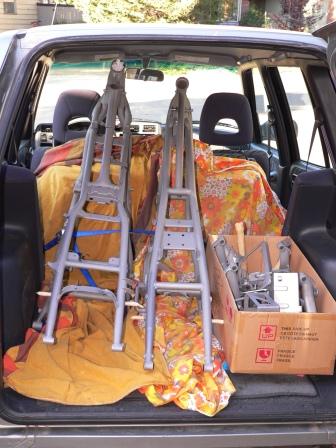
Long ago – September 9th of this year to be exact – I wrote about prepping a few parts and pieces for the local  CVMG Club’s “Powder Day” at a local shop here in Calgary.  After getting all the parts cleaned up at Consolidated Compressor (I wrote about them previously here) they looked as you see in the photo to the left. What you see are two frames – a 1973 Suzuki GT750 to the left and a 1977 Suzuki GT500 to the right. Links to the project sites for these bikes are here and here.

The smaller parts I blasted in a glass bead cabinet, and the frames were done outside, using the Consolidated Compressor high-power sand blasting set up. The glass bead cleaning process certainly was much more ‘gentle’ than sand blasting, safer to use for small parts certainly, and it left a much nicer finish on the items I was cleaning. It was no where near as fast as using sand however, nor was it quite so satisfying – there is something about ripping the surface off of rusty old metal that is strangely appealing ! .  Once I had the parts home, I blew them off with compressed air and then washed them down with brake cleaner, to ensure they were spotlessly clean and free of any oil or grease which would affect the quality of the powder coat. I also used shop gloves (disposable blue nitrile gloves) to try to avoid as much as possible getting any oils from my hands onto the clean metal

I hadn’t actually seen powder coating done before and so for me at least it was quite interesting. The parts are suspended from metal racks using wire hangers to ensure good electrical conductivity, as the parts are polarized to attract the powder (you can see the static charge lead in the right of the photo to the right) and then sprayed using a special electrostatic spray gun. After the powder is sprayed on to the electrically charged parts, everything goes into an oven. Lots of colours are available – I suppose I’m a bit of a traditionalist as I stayed with low gloss black, but perhaps next time I’ll try one of the bright reds or yellows !

The photo below to the left shows the parts fresh out of the oven, and cooling down after baking at 400 F for 40 minutes. Touch-ups are possible – powder coating items with sharp inside edges such as battery boxes or the inside radius of tight bends are a potential issue as it is difficult to get the powder into these areas and I did have to have a couple of pieces re-done, but over all it went quite well.

The last shot to the right shows the parts just before I unloaded them at home !

I have temporarily assembled both bikes as rolling chassis’, as it is much easier to handle them when they are on wheels ! Now the interesting part starts !

Several of the chrome plated parts are in very poor shape, especially on the 1973 GT750 so I’ve looked around for a chrome plating outfit to redo a few of the parts. Its surprising the range of opinion you get when you start trying to get recommendations for custom metal work – many of the folks I asked at custom bike shows advised me to not use any chrome shops in the Calgary area ! On the other hand, shipping costs start to become a real issue with large metal objects, so having someone local that you can easily deal with is a plus.  The other aspect to be considered is the level of re-chroming actually desired. Most Japanese bikes in the 1970’s had relatively poor quality chrome plating. Spot welds are clearly visible for example, and if you look closely there are many small imperfections in the finish – it certainly isn’t the ‘show quality chrome’ you see on modern custom bikes.  Over doing the quality of the finish on a restoration is a common mistake people make, and in many ways detracts from the authenticity of the restored bike, as well as adding a lot of unnecessary cost.

In the end I’ve decided to try Alberta Plating Ltd. as a couple of members of the local Calgary ‘Loyal Order of Water Buffalo’s’ spoke well of them. This week I dropped off a couple of fenders – one of which is in really rough shape – just to see what sort of work they do. They should be ready just after Christmas and I’ll post a few photos. If I like the work they do, then I have about another half dozen bits and pieces for them to do for both the 1973 GT750, as well as the 1972 GT750 I’ll be doing up next winter.

Posted in Motorcycle | Tagged , , , , , , , , , | Leave a comment

Wire Harness

One of the many items you have to deal with while restoring bikes, is dealing with the sins of the previous owner’s efforts to ‘improve’ the electrical system. In fairness some of the ‘correct’ parts are difficult to find, but it also seems as if things electrical confuse and confound many folks to the point where after continued improvement and change, nothing works at all !

The wire harnesses of both the 1973 GT750 and the 1977 GT500 were in very poor shape – many wires had been cut, poorly spliced, the correct connectors were missing, the protective jacket had been removed or it had just weathered away with age.  Replacement wire harnesses are available in some cases from Suzuki, and also from some speciality suppliers such as KnK Cycle but items like handlebar switch gear are generally only available via eBay, and of course these will be the same age and often the same state of repair as the ones you already have. I plan to rebuild the switchgear and repaint it as shown here, but the harness on the other hand is a different challenge.  Luckily, I was directed to an outfit in the USA that supplies most of what I need !

Vintage Connections sells the OEM style fittings, both the 2.8mm latching and non-latching box connectors used in the headlamp shells for the harness interconnects to the instrument pods, and handlebar switchgear, as well as the larger 6.3mm box connectors (latching and also non-latching) used for connections to the regulator panel and ignition coils under the tank. They also sell the black vinyl tubing in sizes suitable for you to replace the protective sheathing leading from the switchgear to the headlamp shell, and from the headlamp shell around the headstock to under the tank, and the leads from the ignition to the electrical connections panel and under tank connections. I like their crimper, although for smaller wire sizes (22 ga. for example) I use a second crimper or sometimes actually solder the joint, just to ensure things won’t come apart at an inconvenient time !

Currently I have finished rebuilding the wire harness for the GT500, and I am ready to start redoing the switchgear sometime in the next few weeks. I’ve done a ‘hot’ test just to ensure the lights, turn indicators, brake switches and horn are all working correctly – so far, so good !

Posted in Motorcycle | Tagged , , , | Leave a comment

1977 GT500 Rebuild – Boots, Seat and Other

Winter has arrived in Calgary with a bit of a thud – lots of blowing snow, wind and cold temperatures – there were supposedly 110 accidents in five hours last night as the storm front blew in from the north. As a result, I’m quite happy to get back to my hobby and spend a bit of time in the shop working on the two old Suzuki’s I have on the go at the moment – a 1977 GT500 and a 1973 GT750.

The GT500 was only produced for two years and is a variant of the very successful T500 Titan.  I’d always wanted a Titan and over the years have very nearly bought one on several occasions, however something (usually money !) always got in the way and it never happened. As mentioned here, I finally picked up a very tired example of a Titan in June of this year from a fellow in Vernon BC, and took advantage of a local CVMG club arranged powder coating day to get the frame and most of the larger bits and pieces made to look new again. You can read about that and also see a few photos here.

One thing about the GT500 variant is of course that there are a few items that are quite specific to those years and that model which are no longer available from Suzuki, and are in fact very difficult to locate anywhere which is a problem if you are trying to do a ‘factory’ restoration – the front fork dust boots for example. These were only used on three models of Suzuki – the 1974 GT550, and the 1976 and 1977 GT500’s. As a result, they have not been available for quite a while and although many parts for other models show up regularly on FleaBay I have yet to see these. Luckily, via the Sundial Moto board (a must if you happen to work on older Suzuki’s)  I was able to locate a fellow in France who is making good quality reproductions of the original pattern, so I ordered two sets which arrived this past week. As you can see in the photo to the right, they look very nice indeed ! The original is on the left, and the copy is on the right – the new ones measure exactly the same as the old ones and will look very smart when I finally get them installed ! If you happen to need a set of these for your rebuild, send me an email and I’ll pass along the fellow’s name and contact information.

As things sit at the moment, I have the GT500 assembled as a rolling frame, and have trial fit a few parts and pieces as much as anything else to just get them out of the way and minimize the chances of forgetting how it goes together while I focus on the 1973 GT750 engine reassembly! I did recently take delivery of a new seat cover from Pit Replica in Thailand – they make replacement seat covers for many vintage Japanese bikes and offer fast turnaround and very good service. The covers themselves may not be the best quality, but they don’t look too bad either so its a bit of a trade off as the pricing is very competitive.

I am still sorting out gauges, fork ears and a headlamp bucket as the ones on the bike were badly damaged. Finding replacements will take a bit of time, so while that happens, I will be doing small jobs such as rebuilding the wiring harness which is in poor shape. I’ll be using parts and fittings bought from Vintage Connections who supply vintage Japanese electrical wiring box connectors, sleeves, bullets etc. I bought a kit containing most of the parts I need to completely repair several typical 1970’s style  Suzuki wiring harnesses, and I expect to have that work done sometime in the next week or so. Hopefully by then the GT750 engine will be back together and in its frame so I can get going on the GT500 engine. My goal is to have all the mechanical items covered for both bikes by the end of February and the parts back from painting by spring, but we shall see how it goes ….

Posted in Motorcycle | Tagged , , , , , | Leave a comment