I just spent the morning in Nanton which is about a 45 minute drive south of Calgary, at the not so small Nanton Lancaster Society museum which features one of the few remaining Lancaster bombers from the Second World War. This plane (FM159) was in service with the Canadian Air Force till 1958, and after being decommissioned was purchased in 1960 for $513 to be used as a Nanton war memorial/tourist attraction and it then sat outside for the next 31 years ! Since 1991 it has been undergoing restoration and this has been very much a community led project – currently the engines are progressively being restored with two in service now, and a third under repair.
When my Dad was here for a short visit a few weeks ago, I took him down for a look, and we were slightly disappointed to discover that the Merlin engine run-up would be happening just after he flew home ! Luckily, another engine run-up was scheduled for today, so I made certain I made it there in time to take it in. I’m not sure where else in the world you can stand within 40 feet of a real WWII Lancaster bomber, parked on the side of a major highway, with its engines running – but you can do that here, and its great ! I shot a short video which can be seen below – the strobe effect you see with the propellers is due to the slow sample rate of the camera and not because they are made out of rubber ! Enjoy !
I’ve been spending a few days preparing several items for the Calgary CVMG club ‘powder coating day’ this coming Saturday. Should be interesting as I haven’t actually seen this done before – other than on television of course ! I hope to have two motorcycle frames ready to go – both are Suzuki’s, one being a 1973 GT750 and the other being a 1977 GT500. I’ve spent the past few days disassembling and getting them stripped down, taken lots of photos and bagged and tagged many of the smaller bits and pieces, nuts and bolts.
Today I spent some time washing off the accumulated dirt and oil from 30+ years of use. I had briefly thought of doing this in my driveway using my pressure washer, but very quickly rejected the idea as it would flush small amounts of oil and grease down the storm drain. Instead, I took everything over to a local Shell car wash as they (supposedly) are set up to keep this sort of debris out of the storm water system.
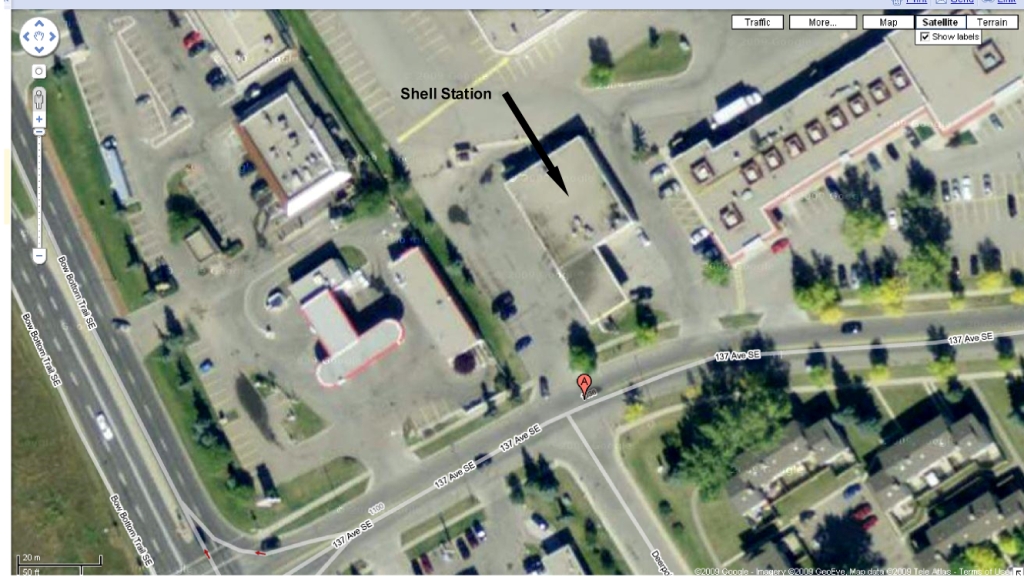
I’ve touched on Shell’s marketing folks and what an odd lot they are previously. Some time ago (before I retired !) I had suggested to the same brilliant marketing folks at Shell that keep closing filling stations so you can’t find one when you need one, that they start to consider the value of putting Shell’s name on the roofs of our buildings. When you consider the number of people using the various free mapping services offering satellite photos that show tons of detail, you would think it would be a no-brainer. A few companies have actually done this in the USA, and Microsoft offers this capability in a virtual fashion with Tim Horton’s coffee shops and Petro-Canada filling stations in some parts of Canada using their Bing mapping service. In the photo to the right, you can see the Shell station and car wash I used – or at least you can now that I’ve pinned a label on it with an arrow ! Imagine how it would look with a big Shell pecten on the roof – this of course hasn’t happened. As I may have mentioned previously, our marketing folks border on genius in much the same way that hammers do – not very much at all actually, but I digress ……
The parts are now all freshly washed, and tomorrow I go over to the good folks at Consolidated Compressor here in Calgary to sand blast all the bits and pieces. I wrote about them previously here , and this time I will be using their indoor glass bead blasting cabinet for the smaller items and the outside sand blasting stations for the two frames. I have to admit, for someone like myself who doesn’t have to do this sort of thing for a living, there is a certain fascination about watching the old paint, rust and anything else that happens to get in the way and isn’t firmly attached get blasted into oblivion – it promises to be fun ! If all goes well, I’ll have Friday to blow out any bits of grit and make sure everything is ready to go for the main powder coating event Saturday morning.
We just had a short weekend away in the Kootenay Lake area of British Columbia – it’s a very nice part of the country, and we were staying with some friends who have a house there. It’s about a 6 hour drive from Calgary, making it just beyond what most people would consider an easy commute for a cottage, so it isn’t quite so heavily built up as some vacation areas and this seems to suit the local folks just fine.
Since we were not too far from Nakusp, we travelled up there for a day to stop in at Wolfgang’s Laverda shop which is nestled away in the hills above Nakusp. It seems like an unlikely location for what is probably North America’s largest supplier of vintage Laverda motorcycle parts and services, but obviously it must work. Wolfgang also stocks parts suitable for other makes and models., and I particularly was interested in picking up a pair or two of the Ikon rear shock absorbers he sells which are made in Australia, very good quality and more importantly are the correct length to fit my GT750’s. We had a good look around his shop and warehouse, sorted out the parts and then had a very nice drive back down to where we staying. The next day we stopped in at Crawford Bay to see the North Woven Broom company. Again, it seems an unlikely place to find something like this, but North Woven Broom has supplied brooms as props for movies and television shows like Bewitched, Road to Avonlea and Shanghai Noon as well as for the Canadian distributor of the Harry Potter books ! Needless to say, we bought a broom for ourselves and it is currently looking very nice in our front hallway !
As I’ve written previously, we generally look for Shell stations as we travel as they are the folks paying my pension, but they sure don’t make it easy. On the way home, it was disappointing to note that we were able to drive 942 km (585 miles) without seeing a single Shell service station the whole time ! Weird.
Giving something useful back to the community is always worthwhile, and as every family at some time or other is touched by illness, accident or tragedy, if that ‘something’ can provide a bit of comfort during a difficult time then I think that is doubly good to do. Victoria’s Quilt s Canada is probably not very well known – certainly people always seem surprised to hear about it when we talk about it, but this is a group of volunteer quilters from across Canada that produces hand made quilts as gifts to patients dealing with cancer. The quilts themselves are beautiful, and the amount of donated material, craftsmanship and time that goes into each one continues to amaze me. These are offered by Victoria’s Quilts Canada to cancer patients in response to requests by a family member, friend or relative – and at no cost to the person receiving the quilt. Here in the Calgary Victoria’s Quilts Chapter, there are about forty-five full time members plus probably an additional thirty or forty quilters who contribute time and additional resources. Its a very good cause.
Shell Canada Ltd. offers Community Service Fund cash grants of varying amounts to specified groups, charities and organisations in which Shell staff and retirees participate, and in 2008 Shell Canada Ltd. donated more than $490,000 to some 350 organisations across Canada benefiting directly from this programme.
Today I was very pleased to present to the Calgary Victoria’s Quilts executive, a generous cheque from Shell Canada Ltd. , which was gratefully received, and which will be used to fund the cost of materials used in the production of quilts for cancer patients in the Calgary and surrounding area. In the presentation photo to the right we have the Calgary Victoria’s Quilt executive who are (from left): Laura Deschner (Vice-President), Sharron Blaine (President), Marilyn Lichtenstein (Treasurer), myself doing the presentation and Donna Sandy (Secretary).
If you want to make a contribution of either fabric (please be sure to check the specifications before donating fabric) or money, or if you are a quilter and want to donate some of your own time just contact the national office or the branch closest to you.
At the moment, this is a North American group, but I suspect groups will eventually pop up in other countries – I think its needed.
My Dad came for a short visit this past week, and as a result aircraft were on the agenda ! He trained at Napier & Sons in the UK, and then after emigrating to Canada was involved for a short while in aero jet engine design at Orenda, working on the afterburner design of the Iroquois engine being readied for the Avro Arrow. While the few completed Avro Arrow’s were cut up for scrap, there are still two Iroquois engines in existence – one in Hamilton, and one in Ottawa.
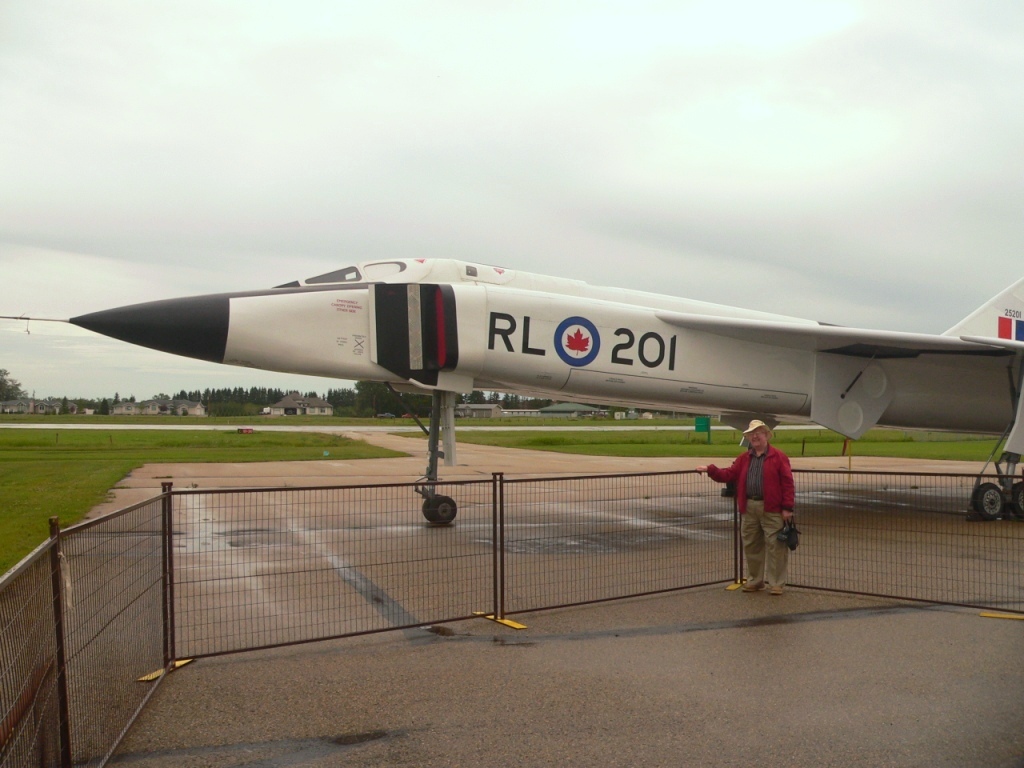
As this year was the 100th anniversary of flight in Canada there were several good exhibits available to visit in Alberta – including the full size Avro Arrow replica in Wetaskiwin, which we visited just over a year ago with my father-in-law Warren, shortly before he passed away. I previously wrote about that here. The Avro Arrow replica is on display is at the Reynolds Alberta Museum and Canada’s Aviation Hall of Fame in Wetaskiwin till September 23rd and (I think) it is well worth seeing – you really cannot appreciate just how big an aircraft the Arrow was till you stand in front of it – the model looks quite good although they obviously had a problem dealing with the weight of the wings and so to avoid them ‘sagging’ there are some supports under each wingtip, which I edited out of the photos I took to mark the event. I suppose that’s cheating, but the photos look much better as a result so I really don’t feel too bad !
One of the other places I took him to, was the Lancaster bomber exhibit in Nanton just south of Calgary. This is a real ‘must’ see as it is one of the very few Lancaster’s still in existence that you can actually go inside of, plus currently two of the four engines actually work – they run them several times per year with the next ‘showing’ being September 26th.
There is quite a story that goes with how this plane came to be in the middle of Alberta – if you get a chance, check it out as the museum, the exhibits and the aircraft on display are well worth a look.
We finished off the week with a day at the Military Museum , which used to be called the Museum of Regiments and which was just recently reopened after a major refurbishment – it now combines museums representing all the Canadian forces. Again, lots to see and of course, several aircraft were on display in the naval gallery.
All in all it was a busy week – checking out aircraft during the day, and then relaxing with a glass of wine while sitting on the back deck watching the activity in Fish Creek Park in the evenings. Its a tough life, but someone has to do it !
More problems – so making a few changes to the project plan.
Once I had the Calgary donor bike stripped down, I was able to put its frame along side the Kincardine frame and then noticed a few differences. Earlier GT750 frames in 1972 had a 2 bolt hole side stand and in late 1972 for the 1973 model year, this was changed to a 3 bolt side stand mount. For some reason, the Kincardine frame was the earlier 2 bolt hole style, and the side stand itself was not original and would need to be replaced. As well, on closer inspection I found that the Kincardine frame had a broken engine mount. The engine and frame for the Calgary bake were original and so the serial numbers very nearly matched (Suzuki frame and engine serial numbers seldom match exactly, and can actually differ by a wide margin). As they were original and close, it seemed a shame to give that up. The frame was cracked in the rear fender stay – not really a key structural member and so could easily be welded. The centre and side stands were both in very good shape. The engine was another story entirely. The Kincardine frame of course had no engine, and so would have been a ‘bitsa’ bike anyway – given a choice then of building a ‘bitsa’ or doing a restoration, I decided to restore the Calgary frame and engine. Of course nothing is ever easy …..
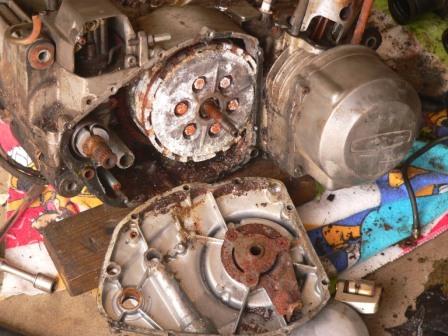
Whenever the Calgary bike had been parked – sometime back in the 1980’s – the oil was allowed to drain out and then it had sat outside in the snow and rain for the next 25 years or so. The barrels came off easily using the puller, but the sight that met my eyes once I cracked open the side cover wasn’t pretty.
There was a lot of rust – my guess is that the engine probably had been in good condition when parked, but over the years had gradually become seized solid with corrosion. Basically other than the cases, barrels, cylinder head and side covers there wasn’t much else I could really use – luckily I have several sets of transmission clusters, and crankshaft assembles so I can replace all the internals with parts from other engines. This does cause a bit of a potential problem though, as the number of teeth on some of the drive and intermediate gears changed over the model years, and I’m not sure which model year cluster sets I have on hand. As well, I will have to mix and ,match the gear sets a bit to minimise the lash in the drive train. Normally there are paint codes on the inside of the engine case, and sometimes on the gear clusters also to assist with lash adjustment, but for some reason this engine had no paint codes inside at all. The water pump, not surprisingly, is shot but I can either rebuild it or replace it. More work than I had expected, but all very doable.
Today I took in a GT750 crankshaft to Greg’s Cycle here in Calgary to have new seals installed. Assuming that nothing much else is wrong with it, I expect It should be ready in about 2 to 3 weeks. I still need to check the barrels to see whether I need to use over-sized pistons, or just re-use standard size ones, but that can wait till after the crankshaft is finished, and I have the gear clusters, crankshaft and all the other bits and pieces back in the cases.
The next few weeks then will be busy getting the above items sorted, plus I have another item I need to prepare for also. Our club is having a ‘powder-coat’ day here in Calgary in early September which I’d really like to take advantage of. This is made possible by a local supplier and basically you show up with your items prepped and ready to go, and take them home freshly powder coated for very reasonable rates. With a bit of luck I hope to have both a GT750 and GT500 frame ready to go, together with all the bits and pieces (battery box, side and centre stands, swing arm etc.).
Of course that means I’ll need to strip down the 1977 GT500, which I haven’t really even looked at yet.
Getting the barrels off of the GT750 engine can sometimes be damn near impossible. What happens is the cylinder head studs corrode, especially the locator studs, and the barrels become firmly stuck. In the past I’ve pulled the cylinder head nuts and then filled the bolts holes with 3-in1 or PB Blaster penetrant from Canadian Tire, left them to soak for a few days or a week and then been able to eventually wrestle the barrels off.
Suzuki actually recognised that getting the barrels off was a problem quite early in the production of the GT750, and made a change to the cylinder head bolt washers (service bulletin GT-5 of May 1, 1975) to try and address the corrosion issues, and also made available a puller (service bulletin GT-25 of August 15, 1975). Both of these service bulletins, and all the others, are available here . The problem with the Suzuki puller, is that if the barrels are REALLY stuck, then you risk stripping the threads you have cut in the barrels per their procedure and then you are totally stuffed !
An alternative is as per the photo to the right which was made by John in the local Calgary Water Buffalo group. Basically its a flat steel plate drilled out in the same pattern as the cylinder head. The plate is bolted the top of the barrels and then threaded rod is run through nuts welded to the plate, down into the cylinder bolt holes till they seat on the studs. Then, if all goes well, you just walk the barrels off by progressively tightening the threaded rod which pushes against the tops of the studs and lifts the barrels up and off.
This is a view showing the barrels pulled up part of the way – you can see the degree of corrosion on the studs which meant they really did not want to let go ! In a case such as this, a puller is almost mandatory.
I was just tearing this specific engine down for parts – it is one of two that was included in the 1973 Suzuki GT750 basket case that I picked up in Kincardine, Ontario. While the barrels, crank and pistons were all scrap (lots of severe damage, and signs of seizure), there was a brand new (or at least virtually unused) nylon water pump gear and as well, the side covers and the actual crankcase halves were in good shape as well. As the pistons were first over size, it looks as if the engine had been rebuilt, and then blown up very soon after putting it back on the road. I’m sure I will be able to use a few of the engine components in other projects at some point.
You can see what the plan is, and follow along on the project progress on the 1973 GT750 project site located here.
For my next project (you can see a list here of what I have planned or completed) I have picked up this 1973 GT750 basket-case in Rubbermaid tubs from a fellow in Kincardine Ontario – basically after hauling a load of items down east for our son’s I was not prepared to come back empty ! It was advertised as being a 1973, but in truth it was a real dog’s breakfast with parts and pieces from several years, although the tank, side covers, frame, front forks, headlamp, radiator side covers, radiator surround, carburettors and exhaust were from the right year. I was happy to get it if only for the parts – the carbs by themselves were worth the cost of hauling it back, plus I expected to be able to salvage at least something from the two engines also included in the deal.
After doing some soul searching, I’ve settled on a way forward. Basically the engines that were included with the basket-case are the wrong ones for the model year, and in any case are not in the best of shape – one has a holed piston, and the other has had some sort of catastrophic mechanical failure that has destroyed the cylinder barrel as seen in the photo to the left. I’m assuming there are still bits of a connecting rod under the leaves at the bottom of the barrel but given the general condition there doesn’t seem to be much there worth saving other then the engine side covers and (perhaps) the water pump. The second engine is slightly better in that it isn’t seized, and other than the holed piston there doesn’t seem to a lot more wrong with it but of course till I tear it down I won’t know.
As I was picking through the Kincardine Rubbermaid containers, Fred and Janice here in Calgary of the local ‘Loyal Order of Water Buffalos’ sub chapter of the CVMG – Rocky Mountain Section, made me an offer which I couldn’t refuse of another 1973 model year bike. This one has been sitting outside since Adam was a boy and is a very tired old soldier, but it does have the right engine for the model year and a few other good bits and pieces so it should work out, assuming that I can get the engine apart – getting the barrels off these older GT750’s can be next to impossible. I’ve borrowed Fred’s puller which should make it easier, but we’ll see.
So the plan then is as follows:
Keep the Kincardine Rubbermaid Suzuki rolling frame seen below to the lower left as it is already nicely painted. The front end has a few problems, as does the centre stand, tank and side covers, but I have some parts on hand left over from the GT/GS750 project bike I finished earlier this year so I don’t expect too much trouble – plus it has paperwork which is a pleasant bonus !
use the engine, instrument cluster, radiator and a few other bits from the donor bike from Fred and Janice seen in the middle photo – most of the rest of the bike, including the frame, is too far gone to salvage. The tank, while not really usable, does have the right pattern for the paint and so will be useful as a guide.
and at some point later this year or next, I’ll have something that will look like the photo to the lower right !
The next step then is to strip the donor bike down, salvage what I can and also go through the Rubbermaid tubs that came with the Kincardine bike to see what should be kept from it. As with my other projects, I’ll keep a record of what I do and problems I run into on a project site, which for this project will be here.
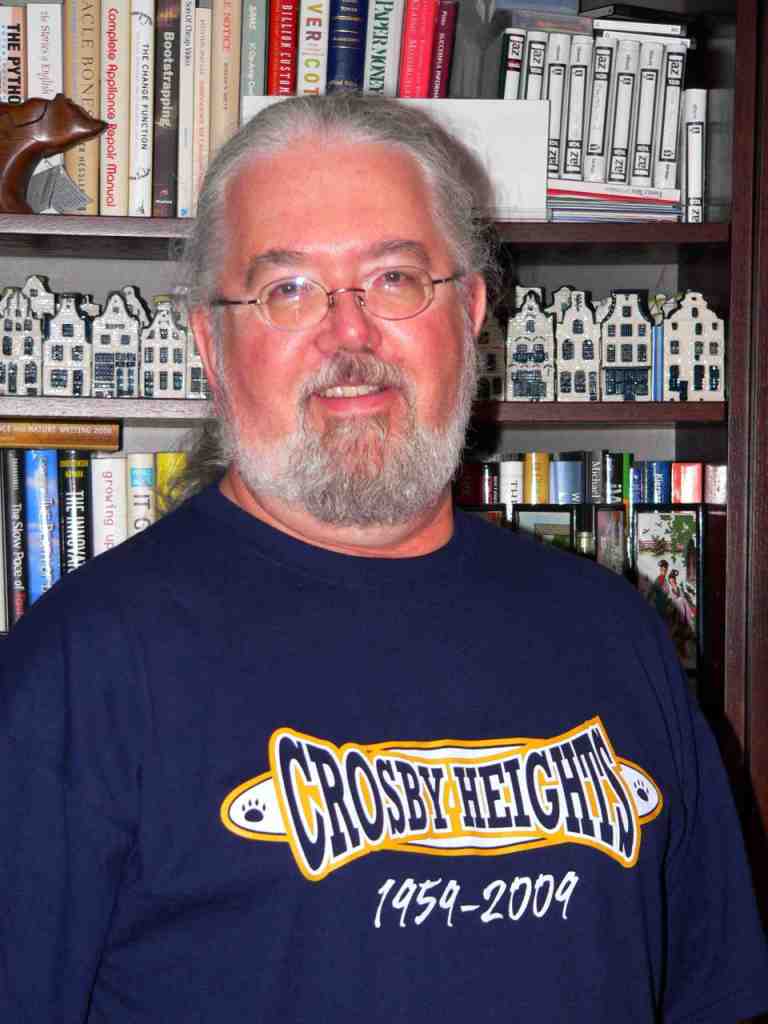
While we were in Ontario for our son’s graduation last month, I took the opportunity to drop by Crosby Heights public school to pick up one of their 50th anniversary t-shirt’s and also to take a quick look around. I wrote about rediscovering some of my grade one classmates and Crosby’s 50th anniversary planning here and so wanted to hear a bit about how the event had gone. Sounds like they had a great time, and walking around the place brought back many memories – once I found the entrance ! The old entrance where the principle’s office used to be (I seem to recall spending quite a bit of time in there ….) was locked as a new office facility had been built, together with a new parking lot and a completely new entrance off of the east side – the school has grown quite a bit and is considerably larger than when I attended !
Once I managed to find my way in, the staff were very accommodating, and I was asked to speak to one of the grade 6 classes in what is now the library, but which used to be part of the north playground when I was there. It was an interesting experience, and there were some good questions from the kids, but as it was pretty much the last day of classes for them I tried to keep it short and let them get on with their summer.
As a part of the preparation for the 50th anniversary event, I had been interviewed by a couple of the grade 6 students (Phyllis and Jansen), and that material had been included in a multi-media presentation the class had put together for visitors to watch during the 50th anniversary event. The class had done quite a number of interviews, and I was impressed with just how well it turned out – they did a really nice job.
As I left, I walked by my 1st grade classroom – yes its still there, and if you took away the TV and the other modern additions perhaps not surprisingly it really doesn’t look much different to how it looked when I was in that same room in 1959. Just like 50 years ago it was filled with the bustle and noise of small children – and I wondered what they will recall of their experience 50 years from now, and whether they will have the honour of being interviewed for a 100th anniversary ………….
We are safely back home again after our trip down east – we were away 20 days, although just nine days were ‘travel’ days and we covered a total of 9,574 kilometres. The average fuel consumption over the entire distance with the Volvo while hauling a trailer, turned out to be 10.6 l/100 km or about 26.7 miles per Imperial gallon and we averaged 84 km/hour over the whole trip. I improved on the fuel consumption from what I was able to get last year, by just lowering the rear tail gate on the trailer to reduce its wind resistance – doing so basically paid for about three tanks of gas and so was well worth it. We had good visits with both my brothers, a few friends and also relatives on my wife’s side of the family, and best of all spent some time with our two son’s. The high point was the graduation of our younger son Derek at York University. All in all, a very successful trip.
We took the trailer so we could deliver a load of items to our sons in Ontario, and rather than come home ’empty’ we dragged back a 1973 Suzuki GT750 basket case seen in the photo to the right (just ‘click’ to see a larger image) which is in a very sorry state, but which does have a few parts and pieces I can use elsewhere if I don’t actually try and restore it. As well, tucked away in one of the boxes, was a possibly rare Clymer repair manual – it is a third printing covering only the 1972 380cc through 750cc Suzuki triples, is dated 1974, and appears to have not been used so I’ll add it to the collection in my library. I need to clear away a few of my other projects before I decide what I’m going to do with the basket case, so it will probably just sit in a heap in a corner of the garage till next year at which point I will include it on my project web site.
While travelling we usually try to use Shell fuel stations as they are after all the folks paying my pension, but after having travelled to both the east and west coasts of North America a couple of times in the past year I can say with some authority that Shell really doesn’t always make it easy for expressway and turnpike travellers to buy their products. We several times fuelled up at Esso/Exxon or some other brand simply because they had advertised ahead on the highway so we knew they were there when we needed fuel – while a Shell station may have also been available, we many times didn’t find out about it till we had passed it. The other thing was being able to easily get to a station that you knew existed. Many years ago, a fellow I worked with by the name of Jerry Beneteau told me that the secret of a successful service station was ‘good dirt’ – it appears that this useful insight has been lost by Shell retail in the USA and Canada, as in a few cases, having confirmed that a Shell station existed, getting to it was not convenient from the perspective of a highway traveller wanting to just fill and go with the least fuss and time investment.
The other thing I really started to find annoying was in the USA being sometimes asked to enter a zip code at the pumps when paying by credit card – of course, being from Canada I don’t have a #$%@ zip code so I then had to go into the office and negotiate with the sales clerk which sort of defeats the whole idea of speed and convenience in today’s self serve world. In one case (not a Shell station) , I actually had to prepay and then go back and get a refund for the amount I didn’t put into the tank ! I can accept the idea of doing something to reduce fraud, but modern credit cards have PIN numbers so rather than creating a new, non-standard method I don’t understand why they wouldn’t just use what already exists ? It seemed to me to be a slightly stupid, non-customer focused process.
When I was working at Shell, I recall regular discussions amongst the retail folks about how to boast sales – I think one easy way would be to stick a few senior executives in a couple of cars for a few weeks, and have them do some actual ‘on the ground’, coast to coast highway learning to see what it looks like from the customer side, rather than from the inside of their offices. I’m pretty sure there would be a few changes made really quickly if they did !