
Burgundy is Brown ?

It has been the most frustrating past few days – I have spent more than just a few hours trying to figure out what the Suzuki paint code is for the colour I want to paint my GT750 project bike. It had been painted with what looked to be 1978 GS750 colours, and as that fit with my design premise I had planned to go with the same colour scheme. I am wiser now.

I had originally thought it would be fairly simple – the ownership/registration said it was ‘brown’, and the side covers and original tank certainly looked brown, but there was an obvious snag with this – none of the GT750’s were actually ‘brown’ so that meant that the registration must have been changed at some point from the original (whatever that was) when it was re-done in GS750 colours. Unfortunately when you start to dig into things, the colour ‘brown’ actually doesn’t show up on the Suzuki colour listings at all, other than for tape used as tank trim in 1978, although there is a ‘brownish black’ listed in 1983. To add to the confusion, when I look at photos of 1978 GS750 Suzuki’s like the one to the right, at least a few of them certainly do look ‘brownish’, so it was a bit of a puzzle which led me to do more than a few searches on the web to try and solve it.

Although I found several good information sources, they each seemed to be short on some detail – the Ozbook site has a really good list put together by an Rick Best, which is a fantastic bit of work, but focuses on Suzuki 2 strokes between 1968 and 1977, and it doesn’t include trim information and which colour combinations were used on the different models of bikes. Another really great source of information is maintained by Jarmo Haapamaki called Suzuki Cycles and which includes data and photos of almost (I’ll be honest – I personally do not know of one he has missed, but I’m being cautious) every Suzuki ever made. This is a site to bookmark as the photos are invaluable, but again, it misses paint code data in many cases, and also doesn’t show which colour combinations were used in each model, other than via the photos. Most of the on line fiches do not show paint code information, other than on the part numbers themselves, but having just a number and no idea what colour it actually was is not a lot of help. Suzuki part numbers of painted items are in the form 00000-00000-xxx, where the last three places on the right are the colour code. So 291 for example happens to be a semi-gloss black, and a side cover for a 1977 GT750B is part number 47211-31200-291, but just by itself, ‘291’ doesn’t tell you much.

Luckily, this is when I found Alpha Sports and I am most grateful to them – they have put on line the full fiche set for Suzuki all the way back to 1965, and most importantly, unlike most other sites, they have not left out the pages with all of the paint and colour combination information !

So – what I’ve been doing for the past few days, is compiling a spreadsheet with this data which will be available from my GT750 project site this coming weekend. A few words of caution – this is a work in progress, and as such will change. It may (most probably does) have a few errors and it is incomplete as I’ve focused on the models I’m personally interested in between 1972 and 1979 (although I have tried to capture all the models between 1965 and 1971) – I also do not plan to include bikes made after 1983 for the moment, as I’m only interested in ‘vintage’ bikes and I somewhat arbitrarily choose to consider those to be anything over 25 years of age ! I have cross checked it with the data provided by Rick Best on the Ozbook site, the cross part reference database from Zedder, the photos in Suzuki Cycles and spot checked against the fiche data on the Power Sport site. The sheet is offered as a PDF – if anyone has data they think should be included, or has a correction they feel I need to make (and has documentation to support it) just let me know via email at oldjapanesebikes (at) shaw (dot) ca.

And the colour for the project bike ? You’ll recall that trying to resolve that puzzle is what started this journey – it turns out that what looks like brown is either a burgundy, colour code 05N or perhaps a maroon colour code 05U or 05L. Now I just have to narrow it down, and then find someone to mix it for me here in Calgary.

Sept 13th update – my first pass at the Suzuki paint code data is now available here.

Posted in Motorcycle | Tagged , , , , , , | Leave a comment

Deep Creek Tool Museum, and "Hit and Miss" Engines

We were in the Salmon Arm area of British Columbia visiting family this past week, and I had seen a sign for the Deep Creek Tool Museum, between Enderby and Salmon Arm off of highway 97B and I was curious as to what exactly it had to offer. Luckily our wives allowed us a ‘free’ morning one day, so my brother-in-law John and I decided to check it out. I’m not sure what we were expecting, but when we got there, at first glance it appeared to be a private home and attached garage in which the museum was housed. It also had a large “Closed” sign out front, but I decided to ring the door bell anyway just to see if anyone was home, and if so what the museum hours were. I’m glad I did, as we ended up having a great visit and a personal tour !

First of all, this is not your “formal” museum with everything neatly tagged, labelled and hidden away in sterile cases – it is obviously a labour of love and life time hobby by the owner, Herb Higginbottom, who was more than happy to give us a personal tour pointing out the various gems he’d collected. Many of these were in working condition, and I was especially interested in his ‘hit and miss’ engine collection. These simple 4 stroke stationary engines were common between about 1890 through to about 1930, and get their name from the sound they make due to the way they govern their speed. Rather than having a throttle, the exhaust valve is held open and the intake valve stays closed when the engine is at speed – as the engine slows, the exhaust valve starts to actuate, and the engine starts to fire. The intake valve generally is not ‘operated’ in the usual sense, but has a very weak spring which allows the valve to be opened by atmospheric pressure when the cylinder pressure drops following an exhaust stroke. These engines have massive fly wheels to help maintain the engine speed, and which are also used for starting them – open the oiler, adjust the needle valve for the fuel (there is no carburettor), grab the flywheel and give it a spin ! He had one connected to a log splitter which he demonstrated for us and is shown to the upper right.

I suppose I’m not the only one, but I’ll admit I hadn’t ever given much thought to how things were powered before the introduction of electricity – I’d assumed things were either done by hand, or with water wheels or draft animals, so another item I found interesting was the gasoline powered Maytag clothes washer – this one dates from the early 1920’s and is probably a Maytag model 82. The little 2 stroke engine, called a ‘fruit jar’ multi-motor due to the shape of the cylinder, sat underneath the washing basin and was started with a small foot operated pedal. Presumably the exhaust gases were vented outside as otherwise, this would have been a real hazard to operate inside the house due to carbon monoxide fumes !

The garage itself turned out to be stuffed with every kind of imaginable tool dating from the late 1800’s through to present day – many old breast drills, foot operated fret saws, small gasoline powered circular saws and all sorts of hand tools, including the only double ended Crescent wrenches I’ve ever seen. It is an amazing collection and Herb can tell you what each one was created for, and how it was used.

In the future, the museum will be easier to find as Herb is in the process of building an 18 foot high (!!) working reel type lawn mower to sit out front, and may also expand the building so more of the display can be kept under roof.

Bottom line – if you like tools then this is the place. We managed to quickly spend a couple of hours and could have gladly stayed longer ! If you are in the area , give it a look see – recommended.

Posted in Travel | Tagged , , , , | Leave a comment

Spark Plugs, Caps and Leads

One would think that the topic of spark plugs would not be interesting at all – heck they have been available and used in engines for over a century ! Not so – there is an emerging problem for older Japanese motorcycles as in some cases, the originally recommended plugs are just not being made. For example – my 1966 Yamaha YA6 calls for an NGK B7HZ spark plug – try to find one ! And if you own an RE5 then you have a real problem as the NGK A9EFP plug was only made for that model of machine, and has not been manufactured for years. And while in most cases it is possible to use a substitute spark plug type in place of the original, the range of options seems to be decreasing as it appears most plugs these days are ‘resistor’ plugs rather than the original non-resistor style spark plug.

All new engines use some sort of resistor in the high tension circuit to suppress RFI (radio frequency interference) caused by the spark as it interferes with TV and radio transmissions. Older Japanese motorcycles put the resistor in the spark plug cap, and have a metal core spark plug lead and a non-resistor spark plug. Cars generally use resistive spark plug leads (carbon) and resistor spark plugs with no resistor in the spark plug cap (not always true, but OK as a generalisation). Resistor style spark plugs started to become more common on Japanese motorbikes as electronic ignition systems (CDI) became more common and pretty much were standard by 1979 – points based ignition systems don’t really care, and actually you do get a better spark with a non-resistive setup on the older bikes as the ignition coils were not that great.The best overview of the issues and options that owners of vintage motorcycles have that I’ve seen recently is here. In brief, as I am staying with points on my old bikes I need to find alternate non-resistor spark plugs – for the project bike, I do plan to use an electronic ignition, so I just need to ensure that the spark plug cap at least is correct and is a resistive cap.

Decoding the spark plug types then is a useful thing to be able to do, and luckily there is a good chart available from NGK if, like me, you are using their plugs. It is available in PDF file format here and another version is available on the web here. This is a useful thing to have for example when trying to confirm the right plug to buy for my old Yamaha as NGK here in Canada was of no use at all – the kid on the customer support desk claimed they had never even offered a B7HZ plug and that I had the part number wrong ! It was almost enough to make me want to buy Champion plugs, but I’m not quite that desperate just yet.

First of all, if there is an ‘R’ in the spark plug label ahead of the number then its a resistor plug which I don’t want. Using the B7HZ as an example, it decodes as follows:

  • ‘B’ is the thread diameter, in this case 14 mm
  • ‘7’ is the heat range – the smaller the number with NGK, the hotter the plug – too hot a plug will burn a hole in your piston (I have first hand experience with that), and too cold will cause it to foul
  • ‘H’ is the thread reach – in this case 12.7 mm or about 1/2 an inch
  • ‘Z’ is for what NGK calls a ‘thick’ 2.9 mm diameter centre electrode

Basically then, if a ‘Z’ plug is not available, a standard centre electrode plug should work fine (a B7HS with the ‘S’ being a 2.5 mm diameter centre electrode) – my assumption here is that the fatter centre electrode was wanted in 1966 as the injector oil fuel systems were new, and fouling would have been common. The injector oils available today are much better, so this shouldn’t be an issue. Given my previous experience with a YA6 and holed pistons, I may actually start off with a colder plug and see how it works – this would be a B8HS.

For the GT750, the NGK B8ES series plugs are still available (the ‘E’ means it has a longer reach of 19 mm or 3/4 of an inch) – but I may stock up on them. I suspect they will eventually be phased out in favour of resistor style plugs as the general demand for non-resistor plugs declines over time.

For the project bike, I just need to ensure that I have the correct resistor caps, ideally with a lower resistance as the OEM ignition coils are not that great. NGK provides a PDF format reference sheet listing the available options which I’ve included here – either the 1K ohm NGK part LB01E, or the 5K ohm NGK part LB05E caps should work fine, with the lower value probably being better to ensure the as much current reaches the plug as possible.

For the ignition leads themselves, generally speaking on older Japanese bikes these don’t really wear out as they are wire cores, and are epoxied into the coils. At the resistor cap end, all that is required is to trim the end occasionally to ensure a good contact with the wire core and the cap. Obviously if you do this too often, you will end up with a very short lead, so it is possible to chip out the epoxy, and then install a new wire core ignition lead, and then re-epoxy the connection.

Enough about plugs – the frame is back from the welding shop, so it is time to get on with a few other things ! The ‘home’ site for the GT750 rebuild project is here.

August 29th Update – I managed to connect with Carrie and Brandon from the US NGK Customer and Technical Support teams, and Brandon has confirmed that, as I’d guessed, the B7HS was the correct NGK plug for my old Yamaha. I still haven’t heard a peep out of the Canadian branch of NGK which is disappointing, but at least I have an answer.

Posted in Motorcycle | Tagged , , , | Leave a comment

Suzuki GT Mirrors and Things

One of the (many) little challenges you run into with restoring old Suzuki motorbikes is the rear view mirrors. The ones that originally came with the bikes in the 1970’s had a Suzuki ‘S’ embossed on the mirror, but none of the after market replacements whether from Suzuki or a third party have this. Naturally, as a result, these original, and now quite old embossed mirrors are in demand and I was following an eBay auction that ended yesterday where the ‘winner’ paid $101 for what was otherwise a $10 mirror ! Actually, I just noticed a shop in Thailand asking $9.99 for a pair of mirrors, so you don’t have to pay much if you don’t want to.

Start

Needless to say, the demand for these mirrors provides an incentive to preserve the ones people already own – and it is not uncommon for folks to install cheap mirrors for general around town riding, and save the embossed ones for shows and events.

I just picked up another bike (a 1974 Suzuki GT550) which looks really nice but in addition to not running also came without mirrors. As I have a few embossed mirrors that would fit it but with broken mirror glass, I thought I’d spend a day and see if I could I could just repair a set that I had. The starting point is shown to the upper left – the key parts are the mirror disc, the rubber beading that holds the mirror in place, a paper spacer that goes in behind the mirror glass, and the old embossed mirror mount. I had to carefully bend the backing a bit to get its original shape back as the back had originally been hit and the mirror arm had been pushed inwards with enough force to break the original glass. After gently (and also not so gently !) massaging it for a while, I was ready to try and add the glass. To the right you see the mirror backing ready to accept the glass. The new mirror glass replacements I got by taking apart suitable third party mirrors which are readily available from many sources – standard mirror glass isn’t suitable, as the mirror is slightly convex to give a wider field of view of the traffic behind you. I found that at least for the ones I used, I could carefully pull the rubber edging at the point where it is seamed, and then the mirror disc you need for the repair is easily released.

I used a heat gun to warm up the metal backing, and then basically pushed the mirror with the edging installed on the edge of the glass disc and very slightly lubricated with some dish detergent (the wider side of the rubber edging, as seen in the photo to the left, goes to the back of the glass disc), until the glass ‘popped’ into place, at which point I adjusted the fit with a jeweller’s fine screw driver so that everything was equally spaced around the edges. If anyone plans to try this themselves, be sure to wear good gloves and eye protection as the glass is easy to break, and gashing your hands on broken mirror glass will definitely put a dampener on your day !

The final result looks ‘OK’. You can obviously tell that the mirror is not new, and the dents and dings are still visible in the photo to the lower left, but I chose to think of these as adding character – heck the mirrors and the bike are both about 34 years old, and its not exactly a trailer queen, so I don’t mind it looking its age. You can see the glass side of the repaired mirror to the lower right.

Bottom line – fixing the one broken mirror gave me a matched set of rare and increasingly expensive embossed Suzuki mirrors for the newest addition to the garage, so I’m happy.
The ‘home’ site for my GT750 project is here.

Posted in Motorcycle | Tagged , , , , | Leave a comment

Blasting in Calgary

I just spent a 30 minutes doing something that was hugely satisfying in a weird kind of way – sand blasting !

The background is that I I needed to clean up some parts for my Suzuki GT750 project (the ‘home’ site for the GT750 rebuild project is here) for welding and painting, and with all the nooks and crannies it was taking far too long to sand the parts down. I have an air compressor, and actually tried out a cheap sand blasting unit from Princess Auto, but several things gave me pause:

  • you really need a lot of air for it to work well
  • the mess made by all the sand flying about is amazing
  • it is not good for the lungs – actually if you want to do this sort of thing, you need either a fully enclosed cabinet for smaller items, or a full head cover with external air feed to pressurize the hood to ensure you aren’t breathing silica dust and paint chips when blasting larger items

Bottom line – not recommended mainly due to safety concerns unless you are willing (and able) to invest the money in the right safety and compressor equipment.

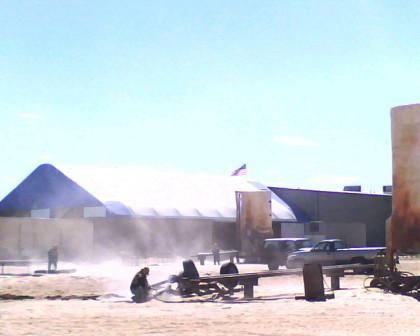
One of the fellows in the RMS branch of the CVMG had mentioned to me, that there was a local outfit here in Calgary offering do-it-yourself sand blasting by the hour so I thought I’d give them a try. Consolidated Compressor is in the east industrial area of Calgary and the rates are quite reasonable. They have about 8 stations, and on any given day you will find several people happily blasting away as per the photo to the right. As I was new to this, one of the folks there stepped me through the ‘how tos’ before I got started. It isn’t a difficult process – basically just point and shoot, taking care not to get parts of your own body in the way ! They supply instructions, gloves and ear plugs, a fully enclosed helmet with external air supply, work areas where you can clamp your work, and all the compressed air and sand you need. Long sleeves and long trousers are a must, and as well it is also a good idea to not park your car too close, just in case you point things in the wrong direction ! The process is fast – paint, rust, etc., just flew off the work pieces I had, and the resultant bare metal finish is ready to go for paint or additional metal working as required.

I have to assume the same sort of service is available in other cities, and if not then that’s a shame because its a great idea !

Posted in Motorcycle | Tagged , , , , , | Leave a comment

Fish Creek and The Partridge Family

It sometimes seems as if my wife and I spend far too much time just watching the day to day real life dramas that play out in the park bordering our property. Fish Creek Provincial Park is one of the largest urban parks in Canada, covering some 1346 hectares , or roughly 3331 acres of land within the City of Calgary.

Lots of larger animals such as deer, coyotes, porcupines, etc. live in the park (and sometimes in our back yard !), but also many birds of all sorts and sizes. We actually keep our own log book of sightings and make a note of new species when we see them. This year, many of the birds nesting in the tall grasslands behind our place have been impacted by the construction of a BirthPlace Forest on vacant city land just to the west of us and bordering Fish Creek Park. The BirthPlace Park is sponsored mainly by BP Canada Energy (I suppose making it the BP BP F ?) and the City of Calgary. While it is tough to find fault with the planting of 6000 trees by an oil company, in the short term at least, it has been disruptive as the high grass west of us was mowed short to make way for the planting of the trees, the building of pathways, installation of watering systems and many birds which normally nest there were displaced elsewhere. I expect it will take a couple of years for things to stabilise.

In addition to two families of Ring Necked Pheasants, one of the real life stories we have been following, has been the fate of a family of Gray Partridges that sometimes comes into our yard to clean up the seed scattered on the ground by the smaller birds from our feeders. What started out as a family of 11 with the 2 parents and 9 chicks seen in the photo to the right, dwindled over the late spring to 6 chicks, then by early summer to 4 and then recently down to just 2 chicks. We thought that perhaps they had finally got big enough to be able to evade the many hawks, owls and occasional eagle which we see in the area, but when we spotted them coming out of the tall grass this week, we saw that only 1 chick remained.

Its possible weather could have been a factor in a few cases and obviously predators have to eat, but it just seems a bit harsh. We are hoping the last chick will be luckier than the other 8.

Posted in Personal | Tagged , , , | Leave a comment

GT750 Restoration Cont’d – Seats, Tanks and Things

The saga continues.

There are a few snags resulting from having decided to do the rear disc conversion on the GT750 I’m working on – although the 1975 2 stroke, and the 1978 4 stroke models have about the same overall length (87.2 inches or 221.5 cm for the GT750 versus 87.6 inches or 222.5 cm for the GS750) the GS750 swing arm is roughly 3 inches (or about 8 cm) longer than the swing arm on the GT750, and has just over an inch (3 cm) of additional wheelbase. I suspect this is a good thing, as it should improve the tracking and overall handling, and also there is room now to perhaps install a larger rear tire. The downside is that the arc that the rear wheel travels, doesn’t look right with the stock GT750 rear fender. As I had planned to use a rear deck and fender off a 1978 GS750, I did not initially think this would be a major problem, however it did result in a number of frame modifications being required for the rear fender mount, the seat and the tank, as well as of the tank itself.

If you compare the photo of a GT750 (left) with a GS750 (right), you can see that the GS tank is longer than the GT tank by about 3 inches, as it extends to just over the side cover, whereas on the GT750, the tank stops roughly even with the front of the air filter boGS750x (red line in both photos). Also noGT750te that although the top shock mount is still in roughly the same location on both frames relative to the steering head, you can see the effect of the longer swing arm in the increased angle of the shock itself (green line).

The problem then, is having started from the rear of the bike to try and get the rear fender to look right with the new swing arm, and extending the frame to allow the rear deck to be mounted in the same manner as the GS750 stock frame, once I have the seat mounted there is a 3 to 4 inch gap to be filled in some way, either between the front edge of the seat and the rear of the tank, or between the rear of the seat and the rear deck being mounted on the fender. You can actually see it clearly in this photo as being the gap (yellow lines) between the scrap rear fender off a GS750 that I’m using for clearance checks as I fab up the frame mount extensions, and the original inner fender that come stock with the GT750.The Gap

I’m tending toward modifying the tank and have mocked up what it might look like in the photo below. Lengthening the GT750 tank actually makes it about the same length as a GS750 tank, and together with the rear deck makes it appear a bit more modern.. At the moment, I’m waiting for a few parts to arrive before finalising the changes, but I expect to make a decision in about two weeks. Nothing is ever easy !

Mockup one


Also – I continue to document what I’ve been doing with this project here,  just to try and keep everything in one place.

Enjoy !

Posted in Motorcycle | Tagged , | Leave a comment

Corteo

Just spent the afternoon at the Cirque du Soleil show called ‘Corteo’ here in Calgary – amazing ! It was the first time I’d seen them live and well worth the cost of admission. Check it out here, here and here.

Recommended.

Posted in Entertainment | Tagged , | Leave a comment

The Trev Deeley Collection

We just arrived back home from another trip to the west coast for some family business – that would be the second one in a month ! As usual, the trip out and in was great as the scenery just can’t be beat, and the drive over the Coquihalla highway and the mountain passes through Banff etc., are always a very easy on the eyes.

On this trip, I had promised myself a special treat and I was determined to re-visit the Trev Deeley Motorcycle Collection . For several years I have been recommending this as a ‘must see’ to friends having a motorcycle interest and who were planning a visit to Vancouver, as when I’d last been there it was without doubt the best motorcycle collection on display in Canada, and probably in the top 10 in North America (the best list of motorcycle museums and collections I’ve seen is available here) . The really amazing and delightful thing about it was that it was a private collection – other than welcoming a cash donation, they didn’t even charge admittance ! And even better – although Trev Deeley was a Harley-Davidson retailer and distributor, the collection he had put together covered all the major marques and featured many British machines from the golden years – Ariel, a Scott Squirrel, Vincent, lots of BSAs and Triumphs etc., as well as other American makes long gone from the market, Italian, German and European models, plus a number of bikes from Japan. The photo to the right shows it as it used to be, and with something like 250 motorcycles from over 50 manufacturers all in one place to be seen, it was an amazing sight. When I heard they had moved to a new location, I naturally had high expectations of the display being even better than before – however when we finally found the new place, I was at least glad they still don’t charge for admission.

Sadly, Trev Deeley passed away in 2002 and the owners of the business either were unable to continue to afford maintaining the old display (I’m sure the cost was significant), or perhaps did not share his vision, but in my own view, the new display location which opened in 2007 is a huge disappointment when compared to what was offered previously. I actually walked by the display entrance initially – it is now co-located inside a H-D store, and the first thing I actually saw when I entered was a collection of motorcycle jackets and boots, with new H-D bikes on display beyond. The new display collection is to the left of the store, up a couple of stairs and around a corner in a series of small low ceilinged rooms – a photo is to the left. Only a portion of the collection of 250+ machines can be displayed at a time, and although the few bikes now on display are restored or conserved to a superb level of condition, overall I just found that the whole thing felt very cramped. To make the best use of the limited space they now have, they feature just one marque, which is not surprisingly H-D. Happily, the few bikes on display are immaculate and often are quite rare examples, but it just isn’t the same as it used to be.

I was told that perhaps next year they will mount a British display, but obviously if you plan to visit you would be wise to call in advance to be sure there is something on display that you’re actually interested in seeing. Bottom line – sad to say, its no longer a ‘must see’, but if you have a rainy afternoon to fill and happen to be in Vancouver, then it could be a pleasant way to spend an hour.

Posted in Motorcycle | Tagged , , | 1 Comment

The Avro Arrow (or "Two Days in Wetaskiwin")

Of the many really great museums I’ve been lucky enough to visit over the years, one of my favourites is the Reynolds Alberta Museum which is about two and half hours north of Calgary in a place called Wetaskiwin (which among other things is known for its water tower which reputedly is the oldest one in Canada !). On the same site is also Canada’s Aviation Hall of Fame which is also well worth a look see. This weekend was the annual Wetaskiwin Air show and so we took my father-in-law up to take in both the air show, as well as to take a look around the Reynolds Alberta Museum (or as it is often referred to – RAM) which I always find fascinating. The museum focuses on mechanical equipment used in Alberta prior to probably the late 1950’s with many of the finer pieces on exhibit clustered around the early 1920’s through the 1940’s – cars, trucks, planes, motorcycles, tractors, combines etc., as well as the more basic sorts of mechanical household items from the early days, such as milk separators. There is lots to see, but for me personally, I find I tend to spend a lot of time in the area of the restoration shop where you can watch restorers slowly rebuilding the equipment to be put on display – currently they are working on an old 1955 Chevy Nomad. This is quite literally a full ground up restoration effort, with many of the body panels having to be recreated by hand. Beautiful work.

Hidden away in one of the buildings on the museum grounds, is a warehouse stuffed with aircraft and vehicles awaiting restoration, and the one I particularly wanted to see was the full scale replica of the Avro Arrow, built by Allan Jackson also of Wetaskiwin, which was used in the CBC film called simply The Arrow. The folks at the RAM were kind enough to let us take my father-in-law behind the scenes to take a quick look at it, and in doing so made him a very happy man for which we are very grateful. The photo at the right was taken by Chris Gainor who has written several articles about RAM and the Avro Arrow.

The family connection is that both my father-in-law, and also my father worked for Avro on the Arrow back in the 1954 through 1959 time frame till the Arrow project was canceled in 1959 by Conservative Prime Mister John Diefenbaker. While the reasons for the cancellation were many and varied, doing so had a huge impact on high tech employment in Canada, which lasted well into the 1960’s – some would argue even longer. In the immediate aftermath of the project cancellation, roughly 14,000 direct employees became un-employed, together with several thousand indirect employees – or roughly the same number as the total population of the city of Prince Albert in Saskatchewan (about 24,000 in 1961) that Diefenbaker was elected to represent ! However you look at it the negative impact on the high tech segment of the Canadian economy in 1959 was huge. The fact that it has now been almost 50 years since the cancellation, and that people are still talking about it is probably the best indication of just how big an impact that was.

To cut a long story short, as we rolled my father-in-law, who is in his 80’s, up to the full size Arrow replica in his wheel chair, the look on his face was a study in both joy and grief all at the same time. Joy at seeing something that meant a lot to him personally, and grief over its cancellation and all that it might have been. While it isn’t the ‘real thing’, it sure looks real, and it was a very special moment.

The air show was great – but seeing the Arrow was definitely the high point, and more than reason enough to justify a visit to Wetaskiwin again in the future.

Posted in Personal, Tech, Travel | Tagged , , , | 2 Comments