GT550 Starter Clutch

The new style clutch basket and starter drive assembly has arrived for the 1974 GT550 I’m rebuilding, together with most of the seals, gaskets and other bits and pieces I need. I managed to track the starter clutch assembly down in the UK from Suzuki-Dave who is a member of the UK Kettle Club, and from whom I’ve bought other items previously. Tracking down all the other seals I needed has taken some time, as some have not been available from Suzuki for quite a while – for example the oil seal that goes behind the drive sprocket ( 09283-25050 ) I finally sourced from a dealer in New Zealand. Most of the crankshaft bearings and the connecting rods are no longer available from Suzuki either, so I’m hoping that the crankshaft I have will be OK.

I spent a very pleasant day up at Fred’s earlier this week washing the engine cases in his parts washer, and they are now look much better. I also rinsed out the crankshaft assembly just to try and flush any remaining small bits of aluminium off the big end bearing etc., and that all looks pretty good as well. As my wife is out of town this week, I very seriously thought about washing the crankcase halves in our dishwasher – this has been done by a number of folks and supposedly works well, however my guess is that they are all single (or divorced) so in the end I decided that I’d better not push my luck with SWMBO’d.

New and Old

As per Suzuki Service Bulletin #GT-26 of August 15, 1975, the new starter drive assembly ( 21200-34820 ) was introduced with engine number GT550-63692 and is quite different from the older style, as can be seen from the photo to the right – the new style is on the left side of the photo with the new starter clutch gear above it (just ‘click’ in the photo to see a larger version). These assemblies come as matched sets and per the bulletin must be replaced as a unit. Of course none of these parts are still available from Suzuki, so anyone restoring these engines will likely have to take their chances.

With a bit of luck, I should have the engine back in the frame by mid week,

Posted in Motorcycle | Tagged , , , | 1 Comment

Reynolds-Alberta Museum (or Wetaskiwin Revisited)

This past week was a real treat as I spent it at the Reynolds-Alberta Museum in Wetaskiwin, Alberta which is a little less than three hours north of Calgary. Folks may recall I last visited the Reynolds Museum last summer when we took my Father-in-law there to see the replica of the Avro Arrow. He has since passed away, but that day brought a lot of joy to him.

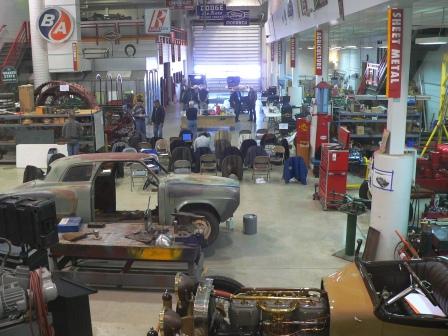
The occasion this time was the ‘Learn from the Experts’ series they offer on museum quality restoration techniques, as applied to the cars, trucks, motorcycles and farm implements that they have on display. These are typically restored prior to being put on display by the on-site restoration staff in the shop attached to the museum, and which is visible from the display areas as shown to the right.

The course itself covered five topic areas: the museum’s vehicle restoration process, restoration of wooden automobile bodies, metal finish repair, surface preparation, painting and types of finishes and finally automotive detailing, repair of small imperfections etc. Other than the fact I was suffering from a bad cold, the week was great and I learned a lot that will be direct benefit to me in what I am doing with the motorcycles I work on, as well as other projects I may try my hand at – much of the wood finishing, repair and refurbishment techniques are as applicable to furniture as they are to old cars.

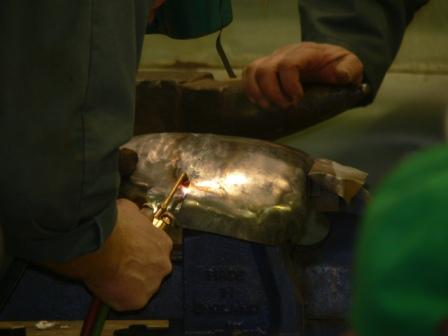
What I’d call ‘old style’ vehicle repairs is becoming a lost art, so being able to be stepped through the thinking behind, as an example, which wood works best for a door post (ash as it happens) or for the roof bow of a car roof (often red oak) was for me at least fascinating. Likewise watching a flat 20 gauge metal panel take on the form of a rolled fender after a few minutes of metal bashing by someone who knows how to do this,  or seeing someone make a huge dent on a fender, and then how to hammer it to the point it was ready for paint by using just hand tools, or the right way to use lead body filler rather than using plastic filler  was great ! In many respects this style of body repair is closer to black smithing than modern auto body repair, as it uses many of the same tools and techniques – snips, hammers, dollies, heat and a good pair of safety glasses.

Needless to say, I learned a lot and I’m looking forward to trying a few of the techniques out on my next project – if there was a downside, it is that I learned that from a metal finishing perspective, I’d probably done the fuel tank on my GT750 project incorrectly and will want to do it over at some point. Of course, this just makes a good project for the future when I’ve run out of other things to do !

Posted in Motorcycle, Travel | Tagged , , | Leave a comment

The 1974 GT550

DonorSome time ago, I picked up a 1974 GT550 which came to me with the engine stuck. As a part of the deal, I also was given two donor bikes of the same model, but different years. Basically, the bike was complete, and just looked too good to pass over even though the cost to repair was probably going to be more than its value. As I did with my GT750 project, I’ve started a web site to capture additional details as the repair work on this GT550 progresses.

As was often the case, the donor bikes had been left outside with the carbs and exhaust pipes removed, so water, snow and whatever was blowing by had made their way into the engine cylinders and they were solidly stuck and not looking very good at all – as per the photo to the left.  After letting the engines soak for several weeks with penetrating oil,  I pulled them apart to see what could be saved, Interestingly, both donor engines appear to have failed due to holed pistons, so naturally I was curious whether the project GT550 had the same problem. As well, I had been told that this model of Suzuki had a fragile starter, but when I pulled these apart both donor bikes showed no sign at all of problems. One of them even still had its starter motor fitted, and when I’d pulled it out, I tried it with a power source, and it spun freely.

At the end of the day, I had about one and a half engines with serviceable bits and pieces suitable as spares – one actually had a set of first over pistons which are quite rare to find now. The barrels were in rough shape, but at least could possibly be bored out, and one set of engine side covers were worth keeping

The next step was to strip down the project bike and see what its problem was. As it turned out, it had more than one. Once the head was off I was initially relieved to not see any holes in the pistons, however the centre cylinder had a lot of small metal particles on the top of the piston as well as in the exhaust port, and once the barrels had been pulled off it was clear where they had come from per the photos below left and centre. The centre piston’s gudgeon pin had snapped, and then the piston had essentially self destructed. The bits falling down from the broken piston were lodged between the crank throws and the case which was why the engine wouldn’t turn over. As well, when I pulled off the clutch basket, the starter clutch assembly basically fall apart as the centre boss had come completely apart. In the photo below to the right, you can see the broken one to the left, and what it’s supposed to look like to the right.

Cylinder Starter

Suzuki completely redesigned the starter clutch assembly in 1975, the year after my bike was built and obviously the updated version had never been installed.  The service bulletin which details the changes and new part numbers is GT-26, dated August 15, 1975 and a copy can be found here. I have two ‘good’ old style starter clutch assemblies from the donor bikes as neither of them had been updated either,  but I wasn’t too happy with doing this as I could reasonably expect the same failure mode again at some point – and as I was putting this on the road for my wife, I doubt she would be impressed if it quit working !

I am looking to see whether I can track down a new style starter clutch assembly and we’ll see what happens. At the moment, I’m waiting on parts, seals and gaskets before I start to put the engine back together

Posted in Motorcycle | Tagged , , | Leave a comment

Windjammer

Every once and a while, you get pleasantly surprised by the unexpected kindness of a stranger – and even less often by someone who has a ‘name’ in the business world. This happened to me recently when I went looking for some parts and pieces to refit my Vetter Windjammer IV for one of my GT750 Suzuki’s.

Back in 1973 when we married, in addition to my newly wed wife, I must admit that I also lusted over what was then the Rolls Royce of motorcycle fairings made by an outfit in the US owned by a guy called Craig Vetter. Back then, motorcycle manufacturers generally did not provide much of anything  other than the actual motorcycle, and there was a good sized aftermarket industry to provide windscreens and pannier bags. Initially this accessories market, with the exception of Harley Davidson accessories, was based in Europe, but as nice people started to meet each other on Honda’s in the US (still, I think, one of the most clever advertising angles invented) there gradually grew a market for similar hardware in the USA and Canada.  Prior to Craig Vetter developing his line of aerodynamically styled  fairings, much of what was on offer was somewhat flimsy, rattled a lot, often looked like an after thought, didn’t really offer much in the way of weather protection and usually did not offer any storage capacity – the Windjammer in contrast was solidly built, solidly attached, provided good weather protection and lots of storage and really looked good. In 1974 when I bought my first new bike, a Suzuki GT750, as can be imagined I immediately (well almost immediately – it took a few months to scrape together enough money to pay for it) went to get a Vetter fairing for it – the model was called a Windjammer II.

Vetter

To say that I was in heaven once I had the fairing mounted on that bike would be an understatement – it was in many respects a dream come true as it made such a difference when riding it.  Fast forward a few years, and most motorcycle manufacturers woke up to the idea that they could build and sell their own lines of fairings, bags and fittings and while imitation is said to be the highest form of flattery, together with changing tastes of motorcycle owners, they basically killed the after market industry for this sort of accessory. The Vetter product line eventually ceased production in 1985. Craig Vetter had actually sold his business in 1978, but has continued to be involved with motorcycle design and various projects including mileage competitions to this day. He was inducted into the Motorcycle Hall of Fame in 1999, and if you follow the link there is a good bio of him and his design accomplishments.

Returning to that 1974 motorcycle – my pride and joy was actually stolen in the fall of 1974, and while I went on to own other bikes and makes and models of fairings I always thought that Suzuki GT750 with its Windjammer fairing looked the best of any that I came to own. When I picked up another Suzuki GT750 in 1986, as may be expected, one of the first things I did was track down and install a Windjammer fairing, although by that time new parts to fit the Suzuki could not be ordered and I actually had to make my own mounting hardware.

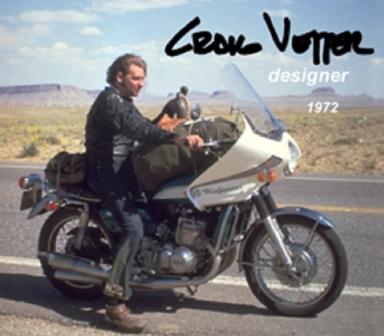
So here it is 35 years after my first Windjammer purchase.  If you check eBay, there is still a very active market for these accessories, and you regularly can see various Windjammer models for sale, as well the the matching Vetter carrier bags together with mounting hardware. The internet and I suppose specifically eBay has provided an easy way to eventually locate almost all the bits you need to put a set together. As I recently dug around the internet looking for parts to refurbish my Vetter fairing, I was pleasantly surprised to find that after all this time Craig Vetter himself is still providing some limited support for his creations in the form of advice, replacement trim pieces and hardware. Better still – he and his wife Carol will actually cheerfully respond in person to queries and requests, and he even sent me a photo of himself on a 1972 GT750 with one of his fairings mounted on it ! You could have knocked me over with a feather, I was that surprised, as this sort of business behaviour is such a welcome contrast to so many other businesses that I deal with these days.

Personal responses, cheerful advice and friendly service – that’s a precious thing in this day and age, and perhaps a small part of why Vetter fairings are still as sought after as they were 35 years ago. Of course, the fact they still look fantastic must also have a bit to do with it !

Posted in Motorcycle | Tagged , , , , | Leave a comment

Getting Organised – continued

Life is never simple is it ?

Following along after my last post, I was just finalising my upload to the Amazon S3 storage, and then had planned to update the removable hard drive we keep in a safety deposit box, but I first decided to take a few minutes and do a bit of spot checking. In this case, the ‘few minutes’ turned into a few days …….. 

As I checked through the photo files I noticed that here and there – not very often, but often enough to be annoying – the thumbnail view of the photo files was not being displayed. I have seen this before, and if you Google this problem you’ll find that it is a commonly known Microsoft feature. In the past I’ve typically just refreshed the file from one of my other backups and continued on. However this time, I happened to try and open a few photos on either side of files which were missing the thumbnail view and found a new problem – here and there although the thumbnail of the photo looked fine, when I tried to actually open the file there was either no valid JPG file there, or the file opened as a black screen. The result varied with the tool that I used to open the file.

I reached for my bottle of antacids, as this was not good at all.

Everyone knows hardware will fail – that’s just a given as stuff does just wear out and frankly you are a fool if you don’t plan for it, but a search of the web showed that, as for the missing thumbnails, file corruption is also a fairly common problem for which the most common connection is the use of Microsoft products. In fairness given the percentage of the market Microsoft  successfully controls this is not surprising, and it could happen with any vendor’s software – it just doesn’t make it any less annoying.  

I’ve done much Googling for possible solutions, but have not found anything that I would call a definitive answer, although file transfers for USB devices and file transfers in general do seem to be a common issue area. In my own case I suspect that my problems may have started around XP SP1 time as there were some reported driver related issues, and I just had not noticed. Vista users seem to have had this sort of problem a lot, giving me even more incentive to not use that product and its related applications, but at the same time I’m not convinced either MAC or Linux based solutions would be trouble free either as it is all software, so by my definition can’t really be trusted. What I have done is gone back to basics, and double checked that I have all the XP patches and applications updates, plus as per a few suggestions I happened across, I have also updated the firmware on the ASUS motherboard of my XP machine. While I was at it, just for good measure I also updated the firmware on my D-Link DNS-323 home server as a number of incompatibilities with this device were flagged when Vista was released. Doing firmware updates to otherwise working hardware is generally something I try to avoid as you can create more trouble than you solve. In this instance although I’m not using Vista, it wasn’t clear to me whether Vista ‘features’ may not have been introduced to XP with the later SP2 and SP3 XP updates, which may then also have possibly introduced similar Vista file corruption problems to my XP platform.

I have spent a lot of time this past couple of days, doing file transfer tests and I can’t reproduce the problem so for the moment at least it is on ‘monitor’. On top of the testing, I have also spent many, many hours going through my full digital photo collection accumulated over the past 10 years, and at the end of doing so have determined that about 15,000 or 25% of the photos were suspect or had been trashed ! I have been able to recover these files from other backups (I’ll admit that I am anal about backups), and then have reloaded these back into my Amazon S3 storage space.

When you consider the digital age we live in, and increasingly the many years of photos and fond memories that exist only as bits either on a local hard drive or as bits kept somewhere else, it is sobering to consider ones digital past could so easily disappear due to a glitch, be it either software or hardware related. Following this experience, my suggestion to anyone out there who is using either XP, Vista or frankly anything else, and who thinks that their photos are all safely stored on either a local, removable or network hard drive, CD or DVD should perhaps take a look at them and do some in depth checking. You may be surprised, and not in a nice way. In the meantime, I’m going to restock my supply of antacids …….

Posted in Tech | Tagged , , , , | Leave a comment

Getting Organised

Well it isn’t even close to being Spring, but it was time to do some hard drive cleanup, so I’ve spent the past few days sorting through the hard drives of my in-home server, backups and the machine I use for photo editing and video processing. As I wrote here last year,  I have been using the Amazon S3 service as an off-site place to store my photos and I use Bucket Explorer as the front end/user interface. The combination works incredibly well, and so when my brother-in-law John was asking about what off-site storage option he should consider for his several thousands of photos, I had no trouble recommending it to him as an option to explore.

John is the same fellow whom I convinced to by an iMac, as he really wanted to just use a computer rather than have to figure out how it worked, and he has been very pleased with it. I am still running Microsoft’s XP for photo work only because I’ve invested time learning Microsoft Digital Image 10 suite for processing my photos, which is similar to iPhoto on the Mac, and I am comfortable using it. Sadly, Digital Image Pro 10 has been dropped as a standalone product by Microsoft, although some of its elements have since been merged into Vista. While I suppose I could change out XP for Vista, (and I actually do have a couple of copies of Vista sitting in boxes unopened)  based on my experience while working on the pilot to deploy Vista in Shell, it would frankly seem more like a down grade from XP rather than an improvement.  I suppose I’ll either have to wait for Vista’s replacement called Windows 7 to be released  and look at it then (actually not till after at least its first service pack is released of course), or perhaps move fully over to Ubuntu’s version of Linux which is what I have running on most of my other machines – or just buy a Mac and not have to mess around as much as you do with Windows products. We’ll see what happens.

As I started into the disc cleanup, it became quickly obvious that I needed something that would allow me to easily check folders and files for duplications and differences in file size, content, etc. I wanted to be able to ensure the photos were sorted, and at the same time be certain that none of the versions of the photos were lost or possibly over written due to having the same file name and yet be different in some way (colour corrected copies, cropped or scaled copies etc).  There are quite a few utilities available to help you manage these sorts of issues, and it is disappointing that something isn’t built into the MSWindows OS as it is a fairly basic requirement. After doing some checking around, I decided to try  a freeware product called WinMerge, and I have to admit I really like it. It sort of reminds me of another utility I used many years ago called F31, although it is much more sophisticated. You can do light weight comparisons based on just date and size, or more extensive binary file comparisons to determine differences in files sharing the same name, and then synchronising the contents of the directories is a snap. Quite useful.

As I type this, I’m just waiting for my updated photo library uploads into Amazon’s S3 environment to complete, then I’ll refresh the copy that I keep on a removable hard drive which I keep stored in our safety deposit box after which I’ll be ready to start on my next little project – scanning and storing my slides, negatives, family films and also a few audio cassette tapes that my grandparents made for us as children.  As they are long gone these many years, it is nice to still be able to listen to them once and a while – and ideally I’ll get the tapes converted before it becomes impossible to find a way to play them !

I expect this will keep me busy for a little while …….

Posted in Personal, Tech | Tagged , , , , , | Leave a comment

Trev Deeley – Revisited

I previously wrote about the Trev Deeley motorcycle collection in Vancouver, and shared the fact that I was disappointed with the new set-up and location. Bevin Jones of the Trev Deeley team sent me a very nice note in response to that post asking me to give them another look , so when visiting Vancouver this past week for my step mother’s funeral, I decided to give take him up on his offer.

The new Trev Deeley motorcycle exhibit entitled “End of Empire” is about the British motorcycle industry and its rise and fall – I first need to say that it does have a nice range of machines on display, and as always the level of restoration/preservation is first class. It would have been nice to have a few more examples of older bikes – the display is weighted toward the 1960’s and 1970”s – but overall it is great value for the money as they still only ask for a donation rather than charging some outrageous admissions fee. My personal favourite, the Scott Squirrel, which is a twin cylinder, rotary valved, water cooled 2-stroke built in 1929 was on display. It was well ahead of its time from an engineering perspective and in many ways may have been the inspiration for the Suzuki Water Buffalo’s that I like to work on, as Scott did develop a three cylinder 750cc water cooled 2-stroke version of the Squirrel just prior to World War II.

Its a pity that as of this writing, the Deeley web site still hasn’t been updated to show information about the new display, even though its been open for about three weeks. As was the case the last time I visited, we were pretty much the only people there which is really nice, but it also may mean a lot of folks are missing out on seeing a great exhibit due to a lack of proper advertising. It is also worth mentioning that the machines on display are not behind glass or mounted so far away that you can’t really seee the details – each bike is very accessible.

One bike of note was the twin rotor Wankel powered 1992 Norton Commander seen to the right- this is one of two that was imported into Canada out of a total of 253 built, and I’d only ever seen photos of this model previously. It will be interesting to see what the new Norton company manages to produce as there have been a number of false starts to date – hopefully this time they are successful !

Bottom line – although I still personally prefer the old display and location, Deeley are to be commended for putting on another good display which folks should try to check out if they happen to be in the Vancouver area.

Posted in Motorcycle | Tagged , , , , , | Leave a comment

Calgary Motorcycle Show

Well, the weekend has come and gone and I spent yesterday (Monday) just puttering around the house after four solid days at the Calgary Stampede Grounds in the Roundup Centre where the 2009  Calgary Motorcycle Show was held. This is a travelling  show that visits several cities at this time of year, providing a welcome break from the winter blahs, and while I haven’t seen the final attendance figures it was a very busy place in our corner of the building.

The local Rocky Mountain chapter of the Canadian Vintage Motorcycle Group (CVMG) had a large number of vehicles on display ranging from a 1935 BMW through to a 1983 Suzuki Gamma, and as Suzuki was featured this year, we had good selection of this make on hand. Front and centre on the RMS CVMG display was Wade’s immaculate and all original 1972 GT750 seen to the right. Also on display was Fred’s 1976 RE5 rotary together with a cutaway of the engine which we (mainly Janice actually) cranked over by hand for hours. It never failed to attract a lot of attention as you really need to see it operating to appreciate just how different an engine design it is, and many people are not aware this type of engine was actually ever used in a motorcycle. It was also very interesting to watch people’s faces as they walked around our display – clearly seeing these older bikes brought back a lot of memories for many people, and you constantly heard parents telling their kids about how they’d had one just like one of the ones on display. The other interesting thing was the number of folks who had been given their father’s or grandfather’s bike which had been sitting for the last who knows how many years in a garage or shed, and who now were looking for information and help to get them running again. Possibly a few of these will be on display next year !

Getting the bikes to the show for all of us was not a lot of fun on Thursday as it was -15 C and snowing, but everyone chipped in and helped each other to unload and push the bikes through the snow in the parking lot and into the Roundup Centre.  Fred set the record for most trips, but I think the one that came the furthest was the absolutely beautiful 1951 Vincent Black Shadow owned by a club member north of the city. Perhaps one of the biggest concerns (other than having an accident) was the amount of slop and road spray there was for those of us using open trailers – after the hours of shining and polishing, the last thing you want is slush, sand and salt spray all over your pride and joy ! Fortunately the cover I had worked well, and I had only a small amount of tidy-up to do once I’d unloaded.

My own contributions were my 1974 GT550, and my project bike with the burgundy tank seen to the left, and which a few of the members call a GTS750 as it is a GT/GS hybrid. For me personally, completing the project was the culmination of six months of very satisfying and rewarding work, and the perfect tonic as it took my mind completely away from cares, pressures and concerns of my former employment, and allowed me to fully disconnect and move into retirement mode.  All in all, it was a great experience, and I’m already looking forward to next year’s show.

Next on the agenda is to get the GT550 running and also do some work on my Yamaha YA6 along with the other usual household items – I suppose at some point I may consider looking for a part time job of some sort, but at the moment I’m not sure where I’d be able to find the time !

Posted in Motorcycle | Tagged , , , , , , | Leave a comment

A Good Day !

Well – today was slightly more notable than most for me as a) it was my birthday, and b) I finally finished my GT750 Suzuki project bike ! I did a small photo shoot out in the -15C weather and the heaps of snow piled at the front of the house and (not that I’m in any way biased of course)  I think  it looks OK. As an added bonus, it also runs although till some of the snow melts, I probably will not be driving it too far.

It will be on display at the Calgary Motorcycle Show this coming week – perhaps I’ll see you there !

Additional photos can be seen here.

Posted in Motorcycle | Tagged , , | Leave a comment

Ignition – GT750 Project

There are several electronic ignition options available for the GT750 and include the Boyer BransdenNewtronic , and roll your own as described on the Pink Possum web site.

BoyerIf you search the web, the kit that seems to have the best reviews is the Newtronics kit as it is packaged as a Suzuki specific item – for example you supposedly do not need to butcher your wiring to install it.  See Gunner’s write up on the Newtronic unit. However, as of this writing Newtronic are no longer in business, although their SU6 kit can still be found if you look, and the new owner – Autocar – may start selling them again. Given availability issues, I went with the Boyer Bransden unit which I bought from Walridge Motors who are the Boyer distributors here in Canada. Walridge Motors is actually a vintage British motorcycle supplier, and they were very easy to do business with, and quite helpful. They also stock the old style metal core ignition wire which is handy for repairing old Suzuki ignition coils if you have the need.

RotorI won’t repeat what Gunner has mentioned about the Boyer Bransden model KIT00083 kit to fit the Suzuki triples, other than to agree that it is a bit disappointing as it is actually a made over kit intended for a Kawasaki and as such it lacks the correct mounting plate, the correct wiring diagram information or even what I’d call ‘good’ set-up information. Having said that, it wasn’t too hard to figure out and install. I did have to modify the Suzuki mounting plate as the rotor supplied in the Boyer kit was too big for the hole in the centre of the points mounting plate as seen to the left – I opened the hole up with a step drill bit. I also made a rubber pad from an old inner tube to fit under the Boyer contact plate which was probably not really required, but seemed like a good idea as the Boyer supplied plate is not very rigid.  The mounted point plate can be seen in the photo below.

PlateOn the plus side – once I had it installed, the bike did start up with no trouble at all so my first impressions are positive. The folks here in Calgary that I’ve spoken to who have the Boyer Bransden unit installed, all seem happy with the product, and several of them have had years of use with no problems at all, so we will see how it goes.

It should be mentioned, that a decent dial gauge is a must for doing the initial setting of the timing, and a good list of available options is offered on Gunner’s site. I actually built my own dial gauge using a cheap unit from Princess Auto (part 2970986) which was on sale, and an old NGK spark plug which I modified to be a holder. It has worked well for me for years at a total cost of less than $10 CDN and is shown below.

Gauge

Posted in Motorcycle | Tagged , , , | Leave a comment