T500 Gets Shifted !

I wasn’t happy with the state of the spline on the shifter shaft on the 1968 T500 Suzuki that I’m currently restoring – it is an odd set-up in that this model was delivered with the option of installing a right or left shift lever or brake arm. Specifically the shifter shaft extends the full width of the crank case and the side covers with a spline on both the left and right sides – normally the gear selector lever in Canada is on the left, and so the left side splines are often worn badly as can perhaps be seen in the photo . But the splines on the right side are normally pristine having never been used, and when new at least were covered with a rubber cap which further protected them from damage. Later model years just had the left side spline and the right end of the shaft was shortened by the amount of the right side spline. However, for whatever reason (likely cost), Suzuki elected to not modify the right side cover, and so the hole where the shaft used to protrude together with its oil seal was left right through till the end of production in 1977, with just the end of the sad little nub of the shortened shaft still visible.

As may be imagined, good usable early shifter shafts are hard to find, but the later single ended ones are more common, and I was able to locate one in very good condition. But how to make it look like the double ended early style ? Luckily Roger, who is a friend of mine and who is also in the local CVMG chapter, very kindly offered his help and the use of his lathe to make the required modifications !  Roger usually works on older British bikes and finds having a lathe very useful as so many of specialised spacers, bolts and fittings are either missing or very difficult to source. Having the tools to make your own missing bits when you have to is sometimes the only option, with the potential added benefit of also allowing you to subtly upgrade selected mild steel fittings to stainless if desired . And referring to the photo – in case anyone is concerned, Roger was wearing safety glasses once the set-up was finished and the machining work actually started.

What we (actually he) ended up with was a threaded hole in the end of the shifter shaft and a turned fitting, that extended the newer style single ended shaft out the right side of the engine cover. The end of the fitting is recessed so that the bolt head is not visible when drawn up, and the whole things is long enough to accommodate the reproduction rubber cap I picked up from Reiner in Germany (just email him at GTReiner1@aol.com, and ask him for a list of the parts he has available) .

It looks pretty good I think, and other than myself, Roger and whom ever reads this, no one will ever know that it isn’t real !

Posted in Motorcycle | Tagged , , , , , , , | Leave a comment

Suzuki 1968 T500 Cobra and Shiny Things

In the past I have seldom bothered with re-plating bolts and fasteners – just a part of my Scottish ancestry I suppose. If the bolt looked reasonable when cleaned up a bit, that was good enough for me ! If I was really concerned about looks I’d replace it with a new one from Suzuki, or in some cases I would replace with stainless bolts. Note that I normally do toss the flat, plain steel washers and lock washers and replace with stainless almost as a matter of course.

New stainless metric bolts have a couple of problems of course – one being they have raised lettering on the heads with the grade of stainless steel they are. This can easily be removed with a swipe on a piece of 600 grade wet and dry paper and then polished up to quite a high shine. The other problem is that the heads normally are too big – the SAE sizes specify a larger head for a given shaft diameter than was used under the JIS system, even after the Suzuki thread pitches were made SAE standard. Honda generally moved to fully compliant sizes, but not Suzuki. This means that in some cases the ‘look’ is noticeably wrong, and re-plating old bolts starts to become attractive.

As well, there are other things that look better when shiny – brackets and cable clip holders for example as well as the tool set, so over the past while I have been cycling through my bolt collections,  and jars of Suzuki specific washers, bits and pieces to have them done. My first batch was done in bright zinc, and as can be seen in the photo to the left I also had the spacer tubes that go under the engine cases done in the yellow zinc that was used at the time. The colour in real life looks a lot better than in the photo, but you get the idea. My last batch was done in cadmium, mainly as it was the same price as for zinc, but also as it should look better longer than zinc will. Honda used mainly cadmium plating on its bolts and fittings, but other than the spokes Suzuki generally used zinc, at least in the 1960’s and early 1970’s.  All the zinc and cadmium plating was done at Wespen Industries here in Calgary who also did the cadmium plating of the front spokes I recently had done. For the spokes it was important to find a supplier that would bake the spokes after plating as otherwise you risk early failure due to to hydrogen embrittlement.

I have included in the batches quite a few of the odd sized washers that were used by Suzuki in places like the rubber stand-offs holding the fenders, or under the instruments. It is difficult to find these in stainless or anything else, and while I suppose a purist would make new ones the re-plated ones will do fine for quite a while I think.

And finally just in case someone asks – while I suspect that the average person would not know the difference unless the two types were along side each other (the zinc is a blue white and the cadmium is more a cold white), for Suzuki at least, zinc is more ‘correct’ and I do know that.

I think I can live with myself – they certainly are shiny !

Posted in Motorcycle | Tagged , , , , , , , , , | Leave a comment

1968 Suzuki T500 Cobra – cont’d

With the new exhaust sorted, the search for the elusive bits continues ! As previously mentioned, the T500 MK I had a number of ‘one year only’ features, and tracking those parts down can take a while. There were about 5,100 produced globally, which means the odds of eventually finding the bits you need are better than with some of the British and Italian bikes that friends of mine restore, but some parts are as rare as hens teeth.

Take the horn as an example – I suspect the reason they are hard to locate is because the design of the mount likely meant they fell off while the bikes were being ridden. It’s a threaded stud with a nut – so two threads to worry about undoing themselves ! I was lucky to track one down in The Netherlands that is incomplete but in reasonable shape, and with a bit of fiddling I was able to get it to work which is always a bonus. I just realised that in the photo below I’m actually holding it upside down, but I’ll make sure I get it right when I install it !

Reproduction Decals sells the ‘Nikko’ label that goes in the small square inset visible on the front of the horn, as well as the 12V label that is attached to the rear .

Hand grips are another problem. Suzuki models in the USA at least were available with a stock grip and a ‘puffy’ touring grip. The touring grip was probably only offered for a couple of years and did appear on the T200, T305, the T500 and likely other models as well under part numbers # 57111-15010 (RH) and 57211-15010 (LH). These are interesting as they are built up from perhaps four separate pieces and then glued together.

Of course, after 45 years, these grips are as hard as rock due to UV damage – a copy is available from Badge Replicas in Australia (and are distributed by Reproduction Decals) but are a one piece moulded design. The thin grips I think were offered for both the MK I and the MK II but still need to confirm that. Paul Miller sells copies of them, and they are reasonably good quality. Below is a photo of a Paul Miller copy of the thin grip on the right, and the touring grip on the left. Something to note about these grips is that the throttle grip slides onto a metal tube and needs to be glued on as the inside lip abuts the throttle cable spool. The design was changed – possibly in 1970 – to have the grip inside lip fit over a flange which then abuts the throttle cable spool.

Handlebars would normally be considered easy to find, but on the MK I bars (56110-15102) the switch gear wiring was run inside the bars, and as well there was a bracing sleeve at the centre between the bar clamps. The MK II was similar, but additionally had a bar brace. The design was changed in 1971 and the wiring was run externally.

To preserve the look, I’ve used a set of the later bars as they appear to have the same rise and pull back as the earlier ones, and have cut the holes in them so I can run the wiring internally, and as well I have added a centre brace sleeve to duplicate the original appearance which should look OK when they come back from the chrome shop. In the photo below, the upper bars are the ones I’ve modified, and the lower set are from a MK II.

I still have a few things to track down – I’ve decided for the moment to stay with the newer style turn indicators as the original ones are very difficult to locate, as they appear to only have been available for a very short time. They differ from the later version that I suspect appeared the same year, in that they used a clamp fitting rather than using a hollow chrome plated stud that was in turn secured inside the lamp housing with a nut. Below is a photo of the one original signal that came with the bike.

The search continues ! Now back to getting the engine sorted !

Posted in Motorcycle | Tagged , , , , , , , | Leave a comment

1968 T500 Cobra – Pipes

Pipes are a pain as chrome shops hate doing 2 stroke exhausts – and here in Calgary while I have had many things re-plated they duck and hide behind the counter as soon as I start to ask about getting exhaust systems redone. The issue is the coke and oil that builds up inside the system – see this previous article I did showing just how much coke can be in even a small muffler. Getting the insides of the pipes clean is difficult, and any residue will ruin the chemical baths used in the plating process so the reluctance is understandable.

I needed a set of pipes for this project and considered how to repair the ones I had. Given the amount of metal work required to hammer out the many dents the easiest way seemed to be to cut the pipes open so I’d have access to the inside which would also allow me to be certain that the insides were spotlessly clean. When considering the amount of work this would entail, the cost to have someone skilled re-weld them back up and then the cost of having them re-plated I came to the conclusion it wasn’t close to being reasonably affordable.

Paul Miller in the USA often sells what he calls ‘show quality’ re-plated T500 exhaust systems – typically for around $400 USD each. With shipping from the USA to Canada then, that is $1000+ CDN for a pair, and while they would look nice they would still have 40+ year old internals which can be a problem. There are a series of welded metal baffles inside the mufflers which eventually can rot out or come loose, so re-plating old pipes without verifying the state of the internal structure is potentially just throwing good money after bad.  So I looked for reproduction exhaust systems and happily these are currently available via Marcel in The Netherlands for roughly the same cost as Paul’s re-plated ones when the total cost with shipping is considered.

The reproduction mufflers arrived from Marcel in NL and he has done a very nice job indeed of having the original look recreated – the shape is perfect, and likely as good a copy as you will likely ever see and of course the internal baffles are brand new. He includes the removable rear baffle and the two seals at the front of the pipe where they connect to the two down pipes.  He has even had the sound deadening mesh installed in the forward section of the pipe so the sound should be the same as the originals (this has been a common complaint with the Delkevic GT750 reproduction systems as while they look great – they don’t sound correct) . There were a couple of minor problems with the chrome on both pipes, but after some discussion  Marcel adjusted the price, and I have had them both re-chromed locally here in Calgary. They look fantastic !

Anyone ordering these from Marcel will get an excellent product, but may want to consider:

a) asking for additional packaging to better protect them during their journey and

b) asking him to inspect the pipes before sending them just to be certain that the quality of the finish is acceptable.

Posted in Motorcycle | Tagged , , , , , , , , , , | 1 Comment

Engine and Transmission

As always there is a story to go along with any rebuild and knowing the ‘why’ of what caused a vehicle to be parked is always of interest to me. In this case, while the bike appeared generally complete, nothing happened when the kick-start was tried – as in it obviously spun over the gear box, but that wasn’t in turn connected to the crank shaft. Once I had the side cover off, all was revealed !

My best guess is that something had impacted the side of the engine case – the clutch basket was broken (indicated by the upper arrow) and the lower arrow points to a section of the crankcase that has been broken and a chunk of aluminium is actually missing. There are no signs of damage to the right side cover itself, so I have to assume it was replaced, but for some reason the rest of the damage was not addressed.

The early Suzuki T500’s had a design flaw related to the oil capacity in the crankcase which was addressed in Service Bulletin T-3 issued in December of 1973. This factory change increased the oil capacity from 1200cc to 1400cc and so addressed premature failure of the 4th and 5th gears, which had been happening since the T500 introduction in 1968. Initially the fix was to install a rubber dam (part number 99104-08800), and then starting with the ‘L’ models the casting was altered and the overflow weir was raised by 10mm. My casting needed to be welded as it was missing a chunk on the underside anyway, and so I took the opportunity to have a raised weir installed at the same time. For this, I fabbed up a small strip of aluminium and had it tack welded in place.


The case repair on the underside turned out really well  – it is visible, but could be hidden if I were to paint the case. As the original factory spec was just bare cases and also as the repair is on the underside, I’m not going to do much of anything to it as I think it looks fine as it is.

In the boxes that came with the bike was actually a lot of information covering the period from 1975 through to 1982, and it appears to have been well cared for during that time. There were receipts for new pistons and also a re-bore, so I knew the engine had been apart at some point.  With the engine pulled apart and laid across the bench, it was time to assess the wear and tear of the engine and transmission. The crankshaft and related bearings and connecting rods all seemed fine. You can do leak down tests on these engines to check if the seals are doing their job, but usually if when spinning the engine over you don’t feel any blow back on the inlet and do feel lots of suction, then the seals are likely in good enough condition for the engine to run. Replacing the seals is not cheap as the crankshaft has to be fully pressed apart, but as the engine is fully apart anyway, I’ll have it done.

The barrels are on first over, and were checked out by Joe at RPM, and I was pleasantly surprised to find that they were still within tolerance so I will just re-ring the pistons and have the barrels honed. The transmission was however another story.

As mentioned earlier, the engine had previously been apart – whether at a dealer or by a previous owner I’m not sure, but the transmission had not been re-assembled correctly and the splash plate had suffered some damage.


Likewise the output shaft needle bearing carrier on the clutch side had been installed the wrong way around and so that bearing had not had enough oil, causing the end of the shaft to be eroded away over time. The worn shaft is on the left in the photo and a good one is shown on the right. Luckily I had a complete, good spare transmission and rather than mix and match gear clusters and risk uneven wear on the gear tooth faces, I will just change everything over.

At the moment, I’m waiting on parts to arrive which is not likely to happen till after Christmas now – so I’ll move on to checking over the electrical system and controls.

Posted in Motorcycle | Tagged , , , , , , | Leave a comment

1968 Suzuki T500 Cobra Tank

The fuel tank obviously had filler – my magnet wouldn’t stick to almost anywhere on either side ! I started to scratch away the filler and slowly the recesses on either side for the chrome tank panels started to reveal themselves.

At the end I had removed 4 1/2 pounds of filler but was pleased to see that the tank itself was in very good shape with only a small dent at the front right side. The threaded bosses that held the screws for the tank panels were like new, and the inside of the tank really had only minimal rust. There was a small hole in the top of the tank – actually under where the filler had been and you could see the staining from the fuel so it had been that way for some time. It appeared to be from some sort of impact by a tool rather than corrosion as the metal was solid.

After removing the dent and giving it a coat of primer, Guy at Cyclemania in Okotoks passed the tank back to me so I could have it cleaned out and lined. This was done by Gary over at Crossroads Radiator. De-rusting tanks using electrolysis isn’t that difficult, but given the time it takes, the mess it creates, the cost of the liner kit if you choose to use one, and then the uncertainty of whether you have got a good coating inside the tank when finished, I have opted to farm this work out the last couple of times.

Guy now has all the tin and with any luck at all I might get it back this year – more probably January. The colour will be a metallic gold candy, as per the original Candy Gold 2, Suzuki paint code 141. Enough of the original paint was preserved under the respray that a good match was possible. Should look nice !

Next up is the engine tear down !

Posted in Uncategorized | Tagged , , , , , | Leave a comment

1968 Suzuki T500 Cobra

As mentioned previously, my winter project this year is the restoration of a MK I which is the first model of the T500 Suzuki’s. It was called the Cobra in some markets, at least till Ford Motor Company decided to object as they already had a four wheeled item of the same name that frankly didn’t look half so good !

This wreck appeared to be fairly complete as it has many of the hard to locate one year only items specific to the model. Included in the deal were a couple of boxes of bits and documentation, including service records and registration history showing that it had lived much of its early life in the province of Saskatchewan before coming to Alberta around 1982. Given it is a first year model, getting it back on the road will nicely ‘bookend’ the production series, given I just recently finished a 1977 GT500 which was the final year of production.

The MK I had a number of ‘one year only’ features:

  • the ‘ski jump’ fully flared front and rear fenders
  • the chrome side panels and fuel level pipe on the tank (note that work needs to be done on the tank – more on that later)
  • the horn was mounted on a centre bolt to the side of the frame, rather than on a bracket
  • the ’rounder’ style side cover and oil tank than was used on later models
  • 34 mm ’round bowl’ carburettors
  • a complete oil pump cover (later ones were cut out to allow the carburettors to sit further back)
  • the bolted style turn signal mounts with a ‘flat’ rear – fairly rare
  • a seat cover having a suede appearance, secured by chromed buttons
  • the left side cover was metal rather than plastic as used later
  • sleeves covering the sides of the gauges that were painted to match the tin

Below are a couple of photos of the bike as delivered:

First on the list is to see what the story is with the tank as in the box of bits were the two chrome side panels specific to this model, but as can be seen in the photo this tank appears smooth with no place to mount the panels !

As always, additional material is available on the project web site.

Posted in Motorcycle | Tagged , , , , | 1 Comment

GT750 Oil Injection Lines

After 40 odd years (I suppose some of them were ‘normal’, but I digress) the check valves in the oil injection lines used by Suzuki for the GT750 as well as other oil injected two strokes are starting to be a problem. Naturally, you can’t buy new ones and of course parts a person could have purchased from Suzuki to try to repair old sets have since been discontinued. The problem area is the small check valve in the end of the line as per the photo below.

Valve

When these check valves fail, the contents of your injector oil tank drain through the pump and into the crankcase. This causes a lot of smoke when the engine is started as this extra oil must be burnt off which, while not exactly environmentally friendly, is a benefit in this part of the world as it reduces the mosquito count. A more serious issue is that in extreme cases, if enough oil has accumulated then a slug of oil can hydraulically lock the engine causing a lot of damage. For this reason, when I first start up my bikes in the spring, I first spin the engines over with the spark plugs removed just to see what, if any, surplus oil there may be.

As others have confirmed, while it is possible to take the ends of the oil injector lines apart there are a couple of issues – one is that even after carefully cleaning and reassembling the valves, they often continue to leak, and secondly my own experience is that it is not easy to consistently disassemble the ends without doing some damage. By this I mean that at the moment I don’t see someone being able to offer a refurbishment service and cover their costs. As a result, like others I was faced with prospect of accumulating a large collection of ‘dead’ oil distribution sets.

Image

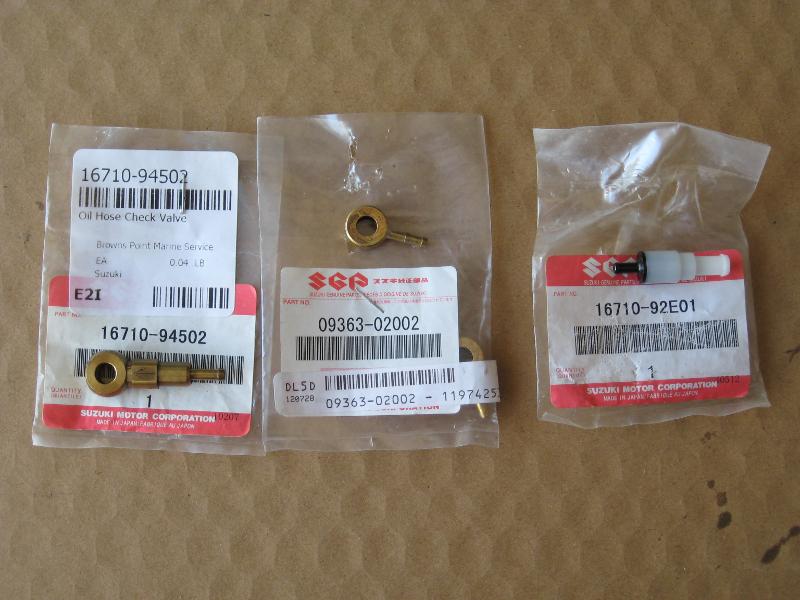
As mentioned earlier, I did do some checking and confirmed that Suzuki did at one time make all the bits you’d need to build your own set-up using the appropriate sized hose.

Image

In addition to the in-line check valve on the right of the photo there is another that I haven’t been able to get hold of under part number 16710-94531. The key part is the check valve banjo fitting on the left of the photo (16710-94502) which is perfect, but regrettably is not longer available. The centre plain banjo fitting is still available.

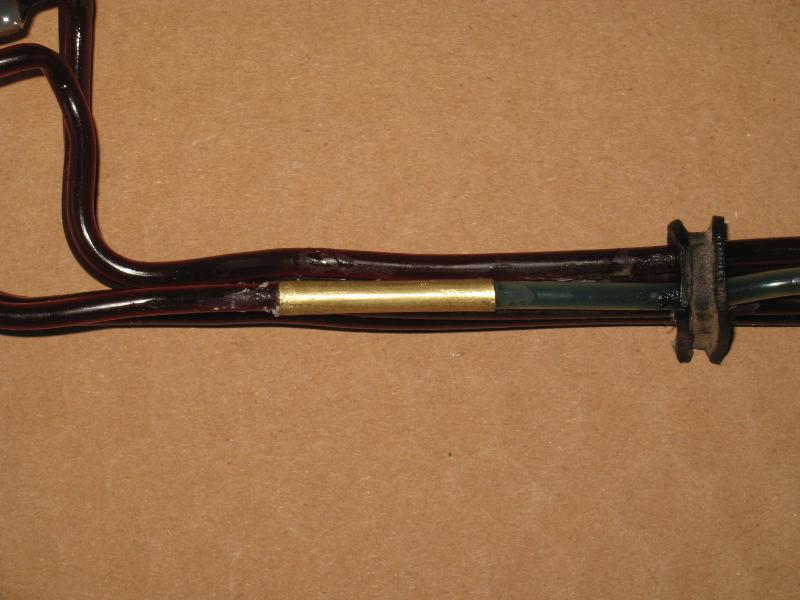
So I have taken another route first suggested by Chris (Coyote on the Sundial board) to splice good components together.

Image

Image

I used some 4mm ID brass tubing from a hobby shop – I did increase the inside diameter a bit as the nylon tubing is nominally 4mm OD and so was often too tight an interference fit. The tricky bit was identifying the correct adhesive as nylon is notoriously difficult to glue. Commercially, and I expect originally, a product called “aqueous phenol” was used as it promotes a molecular bond in nylon to nylon fittings. It is also hazardous and while I have access to some via a local plastics company, I can’t buy it myself. I tried a number of other epoxies and CA type cements/adhesives from hobby shops. You can get CA products that work well on oily environments and which are used in model aircraft, but after doing some testing I found that the bond didn’t hold with the nylon tubing. After several heat cycles and exposure to fuel and oil, I could make most of the joints fail. I don’t have access to the araldite products used in the UK, but after looking at what specification sheets I could find, I’m not sure it would work longer term either. After some looking around I found this product.

Image

The specification sheets for it are located at this link and at this link, and you will see that it has been tested and works well for nylon and other difficult to glue materials. It does not bridge gaps, so close fitting is required.

So – that is my plan for the moment. Rather than try and fix the ends, I will replace them completely by splicing in good ones, and while that isn’t a long term solution it will do for a while. For a long term solution, something like this would be the way to go which was made by Dan in the USA.

Image

This is a hand made aluminium base ring with check valves installed at the ring and then tubing run to plain banjo fittings at the ends. A project for another day I think !

Posted in Motorcycle | Tagged , , , , , , , , | 1 Comment

Suzuki T and GT Resources Site

As mentioned this past February I have taken over the support of the Suzuki T and GT Resources web site located at this link, and since that time have been steadily adding material to it. While there is still quite a bit to be added, it has taken shape nicely with recent additions including:

  • shop manuals covering the earlier Suzuki T10, T20, T305, T250 and T350 models, as well as shop manuals for the GT380 and T/GT500
  • parts manuals for the GT250, the Japanese domestic market GT750 , and the North American GT750
  • owner manual for the GT380
  • an expanded section on service bulletins
  • an owner provided section on various maintenance tips and tricks
  • a video explaining how to convert the GT750 transmission to the later GS750 transmission
  • an expanded frame and engine serial number listing specifically targeting the T and GT500 production
  • and finally a miscellaneous section called ‘Odds and Sods’ for items that do not fit comfortably elsewhere

In the pipeline I have parts manuals for the GT750 covering regional differences for about twelve countries as well as for models sold to police forces in several countries. At the same time I am continuing to refresh some of the original material from the old ‘mraxl’ web site as well as my Internet book called the ‘Field Guide to the Suzuki GT750’ which is being expanded with additional sections and also additional photos.

A new venture I’m trying, is in collaboration with a fellow by the name of Murray in Australia. I have shared with him a load of T and GT500 material passed to me from many T and GT500 collectors, as he already has the most extensive source of T500 information available in one place globally. That data can be found on my own site here . As more material surfaces, both locations will continue to be updated.

All in all it is evolving nicely, and continues to be a free resource to those out there trying to keep these old heaps running, plus as a side benefit I seldom have time to be bored !

Posted in Motorcycle | Tagged , , , , , , , , , , | Leave a comment

ELZ2Coil Accent Electronic Ignition System

Just an update for folks – you may recall in an earlier post that I mentioned I had bought a couple of these units to try out and I had promised to report back … so:

If you are looking for an easy to install, no fuss electronic ignition to fit your GT750 or your GT380 then this is worth considering. The installation was very easy – about 30 minutes start to finish and the kit includes the three stainless steel cap bolts required to fix it. I like how tidy it is – no control boxes to have to hide somewhere as is the case with the Boyer Bransden, Newtronics or Marcel’s system. The circuit board includes an LED (the small red dot toward the middle of the board in the photos below) for static timing – when it lights, just have the centre ‘C’ timing mark on the three armed indicator aligned with the timing mark. With the engine running it can then be strobed to dial it in – in my own case apparently I was quite lucky as I found that no additional adjustment was actually required when I did strobe it, as the initial static alignment was spot on. The only change I made to the installation instructions was to re-install the grommet on the lead where it passes through the side case (see lower photo). The circuit board and components are coated in epoxy on both sides, so I don’t think moisture should be an issue. Also note that the instructions, while they are in English, are not the best translation from the original German – not hard to figure out, but also not as good as they could be. Also note that this will not fit a GT550 Suzuki, so those you who want an electronic ignition system to fit that model will need to check out one of the other alternatives.

My GT750A fired up first time, and then settled down into a very relaxed idle. On the road it feels great and I have now run about seven tanks of fuel through and no problems at all. The fuel economy (not that it really matters I suppose) actually seems to have improved a bit also. Martin Krause of the Wasserbuffel club in Germany has been using these systems for three years now on his touring and racing Kettles so I don’t really think I’m risking too much.

Below is a photo of the unit as delivered, and below that a photo of the unit as installed. As I think I’ve mentioned previously, there is nothing wrong with points and my personal view is that in no way can I really justify the cost of any electronic ignition system for my bikes (I have nine at the moment – five are Kettles and of these two have electronic systems installed). In my defence, as a former IT department manager, I just like to experiment with new technology !

Posted in Motorcycle | Tagged , , , , , , , , | 5 Comments