At last the 1968 Suzuki T500 Cobra is complete and after all the last-minute fiddling that seemed to go on forever, I am well pleased with how it has turned out.
I won’t be able to do too much more to it till the snow melts and the carburettors still need to be dialled in, but I was able to at least have roughly a 30 minute run around the neighbourhood on it before the snow flew. It ‘blubbers’ a bit indicating it is getting too much fuel. Here in Calgary it is normal to have to lean out the jetting due to the effect of the altitude above sea level, so that was not unexpected.
Of course there are still a few things which will likely need to be played with – I expect I will be doing more work on the front forks as they are not what I’d call ‘confidence inspiring’ and seem more like a pair of pogo sticks than anything else. I’ll try a heavier oil and see what difference that makes. And the horn is not as loud as I’d like so I may take it apart again to check the contacts one more time, but that is minor really. As I get a few tanks of fuel through it, I’m sure other things will reveal themselves and need attention as well. On the plus side, the engine pulls well, the transmission shifts properly and the brakes are actually better than I had expected and will get better still as they bed in, so that is all good news !
This past weekend I had it in the CVMG exhibit that we put together for the annual Calgary Motorcycle Show, together with its 1968 Honda CL77 stable-mate, and the pair of them looked quite smart.
As recounted previously (here actually) the fuel cock on the T500 had been played with. Although I had got it to the point it worked well enough, I had noticed that the diaphragm was on its way out and actually leaking slightly as there was fuel seepage evident on the vacuum side of the rubber membrane. This was a problem as these haven’t been available from Suzuki since shortly before the stone age and despite checking with local gasket and materials supply places servicing the oil patch I had yet to locate something similar enough that I would be able to take a run at a repair.
And then I happened across a web site in Germany that seemed to have the solution to my (and many other’s) problems. A fellow by the name of Volker Schultz in Frankfurt, Germany is making replacement diaphragms and repair kits for a wide range of these older Suzuki fuel cocks – and they look really, really good !
In the photo above, the new diaphragm can be seen together with some of the parts included in one of Volker’s rebuild kits which you can order via his web site at this link: www.hard-to-find-parts.de . The site is in German, but most modern browsers will offer to translate the site into your preferred language, and do a passable enough job that you should have no problem figuring out what it is you are looking at. He also sells on the German eBay site – the prices are the same.
Diaphragms are sold on an exchange basis – while the membrane and pintle are new, some other components from the old assembly are recycled and so he needs the complete old diaphragm back. Before installing the new diaphragm it pays to first polish the seating area of the new o-ring a little bit as otherwise you may find that you do not get a perfect seal immediately, although any very small drips should seal up within a few miles of running.
The other thing to note is that the pintles are slightly different, one model or model year to the next. In the photo below, the 1968 MK1 version pintle is to the left and notice it has a shoulder that the MK2 does not have. The valve casting also appears to be a slightly different shape and so the new style MK2 pintle will not seat properly on the older MK1 style valve casting. Just another thing to check and be aware of.
To sum up – I’m really pleased with the fit and the quality of the parts – some obvious thought and care has been put into recreating these, and they do fit perfectly. If you want to retain the original look of the old style vacuum fuel cock, then this is a great service and well worth the effort and the cost.
I’ve had my blue 1976A almost as long as my red 1976A – since the 1980’s – and I use it as my parts bike or ‘mule’ for testing oil pumps, carbs etc, or as a place to hang good spare parts on till I need them. As such it is a bit of a ‘bitsa’ in some respects, but the engine has always been solid. At the moment it is using stock BS40 carbs, stock airbox. points based ignition, stock exhaust and the bottom end and transmission is original. It has standard bores and pistons – the barrels were changed in the 1990’s and some very mild clean up done on the ports at that time. Sadly, it is currently leaking coolant from the water pump weep hole, and smoke and oil billow out of the right side exhaust pipe indicating that I’ve blown out one of the crankshaft seals. Bottom line is that the engine now is very tired, and so I have decided to do a refresh of the engine this winter.
As this is really a bike just for playing with, after several discussions with a friend of mine in the USA, I’ve decided that I might just as well do some mild ‘tuning’ and have a bit of fun with it ! The plan then is to use a lift plate under the barrels, do some clean-up of the ports, skim the head and see what sort of a power boost I can get. As these are piston ported two stroke engines, putting a lift plate under the barrels to raise them (and milling that amount of lift off the top of the block) changes the intake/exhaust timing of the engine analogous (sort of) to changing the camshaft in a four stroke engine. The porting just improves how the engine breathes and skimming the head changes the compression ratio. The net effect – on paper at least – is a boost in horsepower, which can be further improved in a two stroke engine by modifying the exhaust system.
Before doing any work, I thought it would be useful to get a ‘before’ shot of what the engine was producing so I’d have a baseline or ‘before’ view of engine health to compare a fresh engine against. This meant doing a run on a dynamometer to map the horsepower and torque of the engine against rpm. Luckily, a dyno was available at the shop where I have my crankshafts rebuilt in Okotoks just south of Calgary. All I did in the way of preparation was to check the timing and carburettor balance, change the plugs and give it some fresh gas before the run. Here is how it looked on the dyno:
That’s Joe at RPM Services Ltd. seated in the booth amidst the cloud of oil. The sheet you see in the photo is to try and catch some of the gearbox oil being blown out the right side pipe due to the failed seal.
Given the condition of the engine, I wasn’t expecting much in the way of positive results and so was quite pleasantly surprised ! The best run of the five runs showed 55 HP at about 6000 rpm and maximum torque at about 5400 rpm of about 47 ft/lbs. Interestingly, the tachometer read about 240 rpm higher than the dyno recorded at 7000 rpm so it was a good correlation. Ambient air was about 16C. The engine actually improved slightly with each run, and the low cloud of unburned gearbox oil has dampened the mosquito population in the area considerably.
After the rebuild (and more discussions no doubt with my friend in the USA) I’ll re-run the dyno test and see what if any improvement I get ! Stay tuned.
Some months ago (it was here actually), I talked about the reproduction exhausts I purchased from Marcel at Classic Suzuki Parts NL , and while I did have a few issues due to shipping damage, these were quickly sorted out and I put them safely aside till I needed them. With the engine running and most of the build complete, it was time to fit the brand new exhaust system to the bike and then stand back and admire it ! Life is never that easy however, and predictably I ran into another few issues during the install which are worth flagging so that others are not caught unawares.
I had said that they were the correct shape – as it turns out I was wrong. My wife tells me that often, so perhaps sometimes its even true ! The shape is correct, the ‘dimples’ are in all the right places and the diameters are correct, but there are actually two issues that caused me a lot of phaffing about to sort through:
the flanges/seams on the welds are far too wide
the hanger mount on the muffler is off by about 4 or 5 mm (the old ones are about 33 mm off the centre line, and the new ones about 28 or 29 mm)
This meant that when mounted on the bike, the mufflers I received (I have no way to know if this is true for all the ones Marcel sells) were tight to the lower frame rail, and the lower weld flange was in the way of the side stand so it could not be mounted. In the photo below, the arrow points to an original muffler on the top and to the lower weld flange/seam – you can see its almost non-existent. On the reproduction muffler below it you can see that the flange is quite wide and extends about 8 mm further than the one above.
To fix this, I had to shim out the muffler at the hanger using some stainless washers so that when bolted up it would just clear the lower frame rail, and I then used a block of 9 mm stainless steel plate to shim the side stand so that the side stand pivot bolt can clear the under side edge of the muffler. That actually has a positive effect as it means the bike stands a bit more upright on the side stand now, so it isn’t all a bad news story.
So to sum up, were I to do it all over again I’d still buy from Marcel – they do look and sound fantastic (Marcel’s pipes have the metal mesh in the forward pipe area that Develkic neglected to install in their GT750 pipes making the Develkic pipes sound tinny) and are a well made, quality product. It is just that as with most British bikes, ‘some fitting’ is required’.
Moment of truth – the engine started up on the second kick this past weekend and it sounds great ! I still have quite a few i’s to dot and t’s to cross, but the timing is now dialled in and the carburettors set well enough at least for testing – on to the final finishing !
I’ve been playing with the Mk1 T500 fuel cock – this one had been butchered at some point in its life and as well Suzuki doesn’t sell most of the consumable parts you need to repair them. In the photo below, the face seal item 1 is not available, but as Mikuni supplied other brands, I was able to use a Yamaha part (137-24523-00), and also could have used a Honda part (16955-268-020) as they appear to be interchangeable. items 2 and 3 are still available from Suzuki, the screen item 4 is not, neither are the filters (5). The small atmospheric vent gasket (item 6) was not listed by Suzuki but is the same as the Kawasaki part 92065-052 which is also not available, but which you sometimes see on eBay. The diaphragm item 7 can be re-manufactured by an outfit in Germany at this link. These are the same size as are used on the Suzuki J/K triples, although the pintle in the centre is shorter by about 1.5 mm so if you do go the re-manufacture route, make certain you get yours back, and not one that fits a triple. The o-ring on the pintle itself, item 8, I replace with a viton ring of the same size (and I use a method suggested by a friend of mine – Rick – of using a bamboo chopstick to polish the seat that the o-ring seals to). The spring – item 9 is shorter than the ones used on the triples (to match the shorter pintle) and so are unique to the twins. Item 10 I’ll get to in a minute.
This fuel cock had been apart previously ( the screw heads were well rounded ) and someone had drilled out the check valve in the back plate. Till a year or so ago I hadn’t realised there was a valve in these. Allan, another friend of mine, mentioned it to me in passing as we were talking about methods to get these vacuum valves to seal properly. I’m pointing to the check valve in this photo.
Normally, if the check valve working, if you gently blow or suck on the vacuum line connection you can hear the valve click, plus when blowing it should shut and not allow you to easily blow through the valve. On bikes that have been sitting for years, these check valves set up (corrosion and in one case of mine a spider nest) and get stuck. If you have one handy, look at the hole I’m pointing at in the photo and you will see there is a small – less than 0.5mm – restriction hole visible. On this fuel cock, the check valve had actually been drilled out completely with roughly a 1/8 drill. I suspect the effect this would have is that the fuel cock would be slamming open and closed as there is a lot of pulsation at the carburettor inlets on 2 strokes, which in turn would have affected fuel delivery. As this valve was messed up anyway I took it apart to see what the internals looked like.
In the photo below, the cavity the arrow is pointing to holds the valve. You first have item 3 which is a small rubber gasket, then item 2 which is a small brass plug which normally would have a restriction orifice of about 0.5mm in it. This plug slides into the brass housing item 1, the head of which is what you can normally see when you look at the inside of the back plate. I have a box full of J/K fuel cocks for GT750’s – some are working correctly and others are seized up – on this one for the T500, item 2 was actually seized in the barrel (item 1) whether from having been mutilated or corrosion is difficult to say. If the valve is seized the fuel cock should still work – although probably would be slow to open and so restrict fuel flow initially. And if the orifice is plugged with spider web or something else, it won’t readily open at all and so starve the engine of fuel.
I released the brass barrel that holds the valve plug by using a Dremel to relieve the punch marks holding it so I suspect that it may be possible to actually repair these in those cases where you want to maintain the originality.
One of the problems to be dealt with on my 1968 Suzuki T500 was the seat pan. As is usually the case, mine was rotted out around the perimeter and while it was repairable I also was interested in seeing whether there were other options available. Later seat pans are a different shape and profile – the one used on the Cobra was another ‘one year only’ item so using a later pan was not a perfect option. Repairing what I had was doable – but to get it done well (ie: by someone other than myself) was going to cost a few beer tokens. So it came down to, which option was the most cost effective – repair or replace.
There were some discussions with other owners around the globe about getting Cobra seats reproduced, but after well over a year I got tired of waiting and so I contacted a place in Vietnam that was selling rough and ready pans and covered café racer seats just to see if they were even interested in doing a low volume pan for me. After a few backs and forths via email and a phone call, I sent my old pan to them and then somewhat nervously sat back to see what would happen. If it all went into the ditch, then not only would I not have a new pan, but I wouldn’t have the old one either and so be completely scuppered as these things are as rare as hen’s teeth.
After even more emails, the pans finally arrived back here in Calgary today, and I admit that I was pleasantly surprised ! The new one is a pretty faithful copy of the old one and fits not too badly at all. In the photo at the top, the old original is in the upper half and the reproduction is below it. As you can see the new pan has been hand formed – basically a sheet of thin gauge steel has been pounded into the right shape using a hammer and dolly. As a result, it is not a 100% faithful copy – the edges of the pattern are not crisp for example – but it is a good likeness. The second photo to the upper right shows the two pans – original on top, new one below it – and as can be seen, the profile is very close to being the same. The one thing I’d ask for next time is for a stiffener to be spot welded around the inside edge as I’m not as svelte as I used to be, and I think some added rigidity would be wise (note that the original one did have this) . Of course, the pan is covered, and then bolted to the frame (this model does not have a hinged seat) and so you can’t even see the underside of the pan once it is installed – certainly not the top either – so really, so long as the profile is good and the shape is correct then frankly I’m OK with it.
The original padding was not foam, but rather a sort of composite rubber that was deep in the centre of the pan area and then tapered out to the front and the back so as to look flat when covered. the third photo immediately above shows the original pan with the original rubber foam on it, and the third photo shows the new pan with the original rubber foam.
My plan then was to have it re-covered with a thin layer of new high density seat foam material on top of the original, just to soften it a bit and restore some of its shape. I had a replacement seat cover that closely resembles the original look – again, this was a one year only special suede look leatherette which is hard (read expensive !) to find. I think the final result looks pretty good !
If you need a 1968 Suzuki T500 Cobra seat pan for your own use, send Truong an email at this email, and tell him you want the same as what he did for me. He also has a web site at this link if you want to see what else he has to offer.
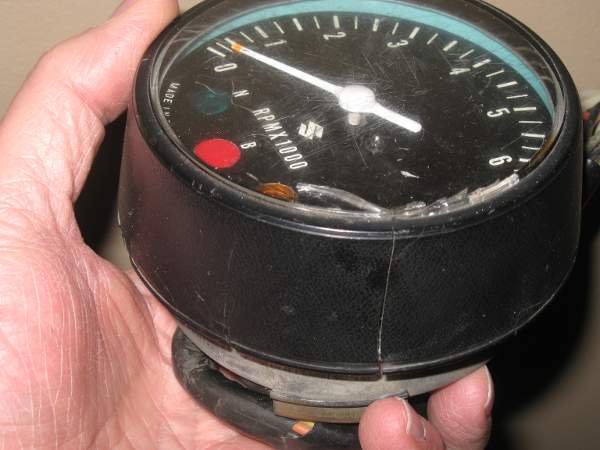
When I picked up my 1972 Suzuki GT750J rebuild project, there was an obvious issue with the gauges. The plastic gauge shells for my speedometer and tachometer were both cracked up into the lens, and when I started asking around I found this was a common issue and specific to the 1972 model. Some folks have tried to glue up the shell, but I do not consider this to be a long term solution – and of course if the crack has extended up into the lens then the shell is scrap anyway as per this photo to the right.
The rest of the instrument is not usually difficult to repair – but the plastic housing and lens is unique to that year, and from the research that folks like Allan have done, also unique to Suzuki for that model in that year. So a couple of years ago I started to look at replacement options – my first step was to have a set of original gauge shells modelled in 3D by a small local company( 3 Print Dimensions) here in Calgary. What they did was first laser scan an old housing, generate a CAD/CAM drawing with simulated texture applied to the wire frame drawing, and then print a copy using a 3D printer. On the left is a printed 3D model I had made from the CAD/CAM drawing. It is in an opaque plastic as the intent of the model was to double check fit, shape and finish.
The 3D process has really improved a lot in the last short while, and affordable table top 3D printers are almost within reach of the average home hobbyist. But if you want to make a product that has a highly polished surface like a lens for example, it currently isn’t a suitable manufacturing option, and as well is quite expensive on a per unit basis.
Originally I had thought of using a one piece injection moulded design done in clear plastic, and then gauge restorers would have had to paint the outside of the shell to suit. The tachometer and speedometer housings are basically identical, with the obvious exception of the hole for the reset knob in the speedometer, which would have had to be drilled. I had considered duplicating the water temperature housings but they generally are not in bad shape, they clean up well and they seldom crack the way the tachometer and speedometer housings do so for the moment I have not pursued the idea.
After a number of design iterations and working with a plastics injection moulding and engineering company in Edmonton (Flexcim Services) I finally decided to make the shells in two parts as was originally done by Suzuki. I should mention here that the engineering design and construction was handled by Gordon Baker and Gary Penney who were both more than helpful, offered great suggestions and support, and never got tired of answering my many questions (or if they did, they at least hid it very well !!).
Here is an example of the early test batch done to validate the fit and shape – these were shot in clear for convenience. In the upper left you can see a test piece mounted on the metal base and inner sleeve. In the foreground are the blanks shot for the housing and in the upper right the lens. In the lower right is an original part I’ve used as a base comparison. Note that the housing is filled from the middle, across the lens face and then equally down sides. The idea is to ensure a uniform strength shell which should be stronger than the originals.
The process then is to shoot the black housing, CNC machine the face of the housing to receive the clear plastic lens, machine the hole in the side of the speedometer shells at the correct angle and recess the inside of the shell to ensure proper clearance of the reset knob tube, then glue the lens into the housing.
These show the assembled lens and housings, with the housings shot in the black plastic. Original housing on the left and the reproduction is on the right in both photos.
The last step was to get the texturing of the polished injection mould done, and here to the left we see the copied part with the texture added – original on the left, and copy on the right. The two small nubs you see on the top of the one on the right are locator pins for the CNC fixture so ignore them. Also – the one on the right doesn’t have 40+ years of hard life and sun damage. 😀
So – I there you have it ! I now have copies of the original shells for my own restoration and also have a few for others also restoring these iconic machines. This next photo shows the shells fresh off the production line at Flexcim. If you look at the photo closely, you can see both types (tachometer and speedometer). The material used is polycarbonate for the black case and an acrylic for the lens, which is then solvent welded to the case. Each solvent welded seal has been water tested to check that the joint between the clear lens and the black case is complete.
Here is a photo of the trial fit of a new speedometer shell, re-using the reset knob spigot from the old shell.
Replacing the shells is not difficult, but typically that isn’t the only repair required. Usually the needle needs to be repainted, the dampening fluid needs to be replenished (to dampen needle bounce), the instrument mechanism needs to be cleaned and calibrated, and the trip and odometer reels often could stand to be rejuvenated with new numbers. Possibly the face will also need repair as well. So:
while most people can do the basic shell replacement themselves, for the best results and a set of clocks/gauges that look like new, I strongly recommend that you use the services of a clock/gauge restorer – at the time of writing, both Gary Mellors in the UK and Allan Tucker in Barbados are known by myself and others to do good work.
I cannot accept any responsibility for your results, or the results of others.
Now – there is this T500 Cobra that I need to get back to …………………………
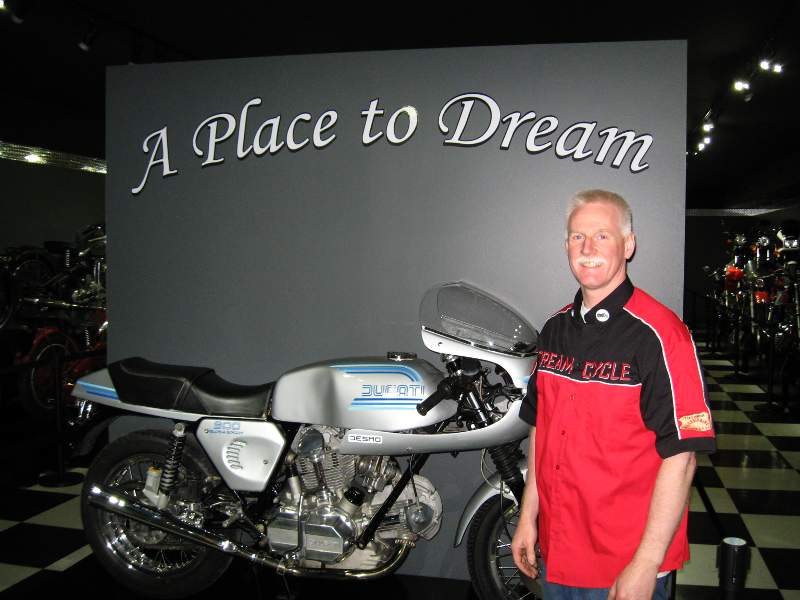
On the way back from my Dad’s place in lower coastal area of mainland British Columbia last week, I stopped in at the Dreamcycle Motorcycle Museum. This is a relatively new museum which opened in May of 2012 and is located on the south side of the Trans-Canada Highway, east of the small town of Sorrento in British Columbia. It is owned by Mark Lane pictured to the right, and it is well worth a visit if you are lucky enough to be in the area ! The hours of operation vary with the season and are updated on their web site which can be found here, and the admission is $10 which includes the audio tour guide.
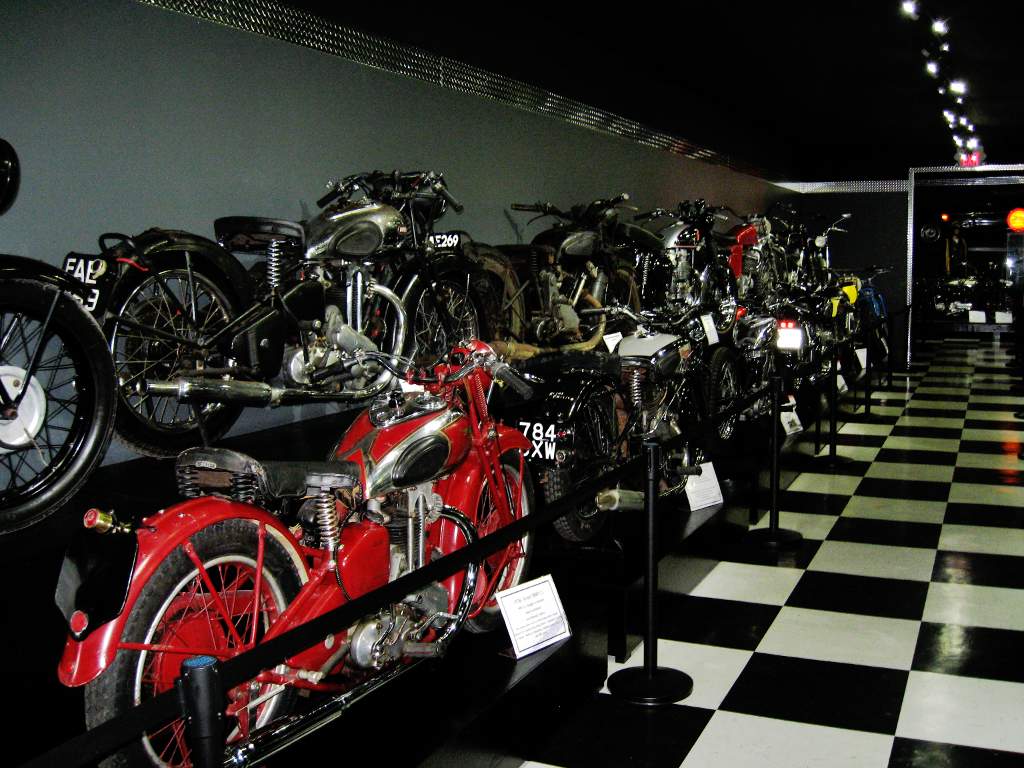
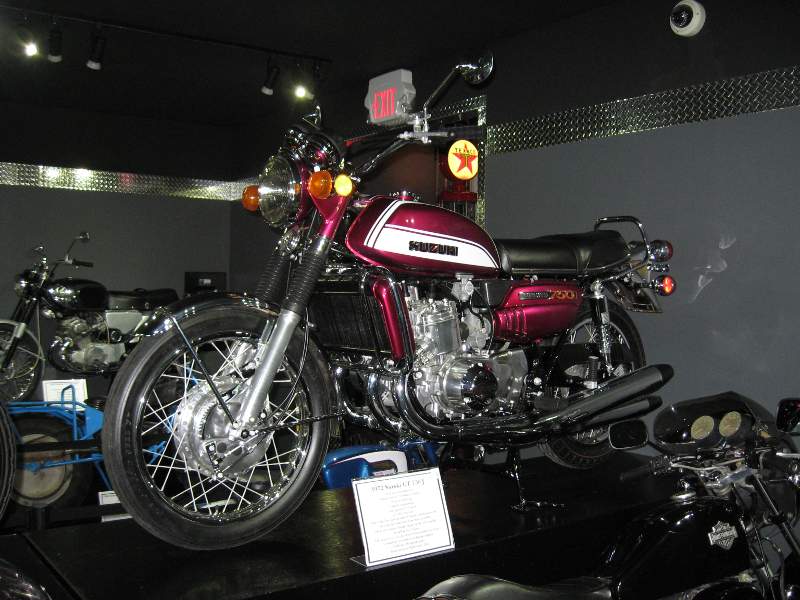
The growing collection has a broad selection of roughly 85 British, European, American and Japanese motorcycles currently on display, ranging in years from 1924 through to 2002, with plans to increase this to eventually be about 100 machines. Included in the collection was a very nicely restored example of my personal favourite model ( the Suzuki GT750 in case you were curious ), but as well there was a very tidy Scott Squirrel, a 1973 Gt550 in all original condition with only 2.8 miles on the clock (!) and at the back of the display area was a T500 waiting to be restored.
Behind the display area there is viewing access to the very well equipped restoration shop where machines are prepared for display. The day that I visited, there were several machines from the recently purchased Delta-Niner collection just being unloaded which will be added to the display over the summer. These included a really nice looking 1947 Vincent, some Manx Nortons and several other interesting machines.
The gift shop features motorcycle themed items from suppliers local to the area which is a nice touch, and just behind the gift shop is a small theatre with seating for about twenty visitors, where short video clips featuring motorcycle races and related topics can be viewed.
During the summer, every second and fourth Friday of the month is a motorcycle drive-in with a BBQ featured between 6:30 and 9 PM – if you show up at some other time then beside the museum is the Sprokkets Cafe which is open year round and is also well worth a visit featuring a broad selection of home made soups, sandwiches and speciality desserts such as the ‘Moto Guzzi Muffin’ and the ‘Suzuki Cinnamon Bun’ !
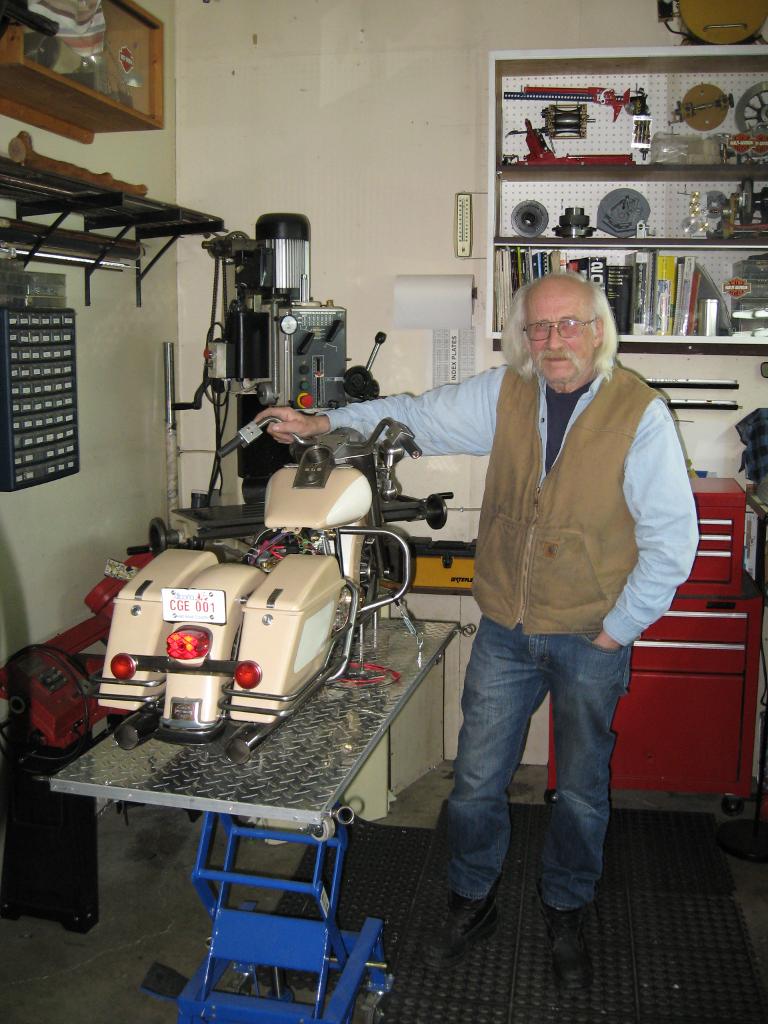
Clarence is a remarkable fellow ! On his retirement, much like myself, he decided to redirect his energies to doing something he enjoyed after many years of doing things for other people, but unlike me he has a real gift for doing precise machine work. His projects are 50% scale, built from scratch motorcycles modelled after his 1979 Harley Davidson FLH. The really cool thing is that he started with no plans, no drawings and no real training in metal turning, shaping or casting. What he has created is really quite amazing, even going so far as to cast his own lenses for the headlamp and accessory lighting.
Clarence gave a talk a few weeks ago to the CVMG NORAL section in Edmonton which I had wanted to attend, but life got in the way. This past week I had occasion to be in the Edmonton area on other business, and contacted him to see if he was open to a visit. It was a great evening and the time past very quickly as he walked me through what he had done and also what still remained to be done. If you are at all into machine shop operations, process and design then he is a great guy to spend some time with – I learned a lot in just a short time.
The areas that interested me personally were the tooling processes for making some of the shaped sheet metal items such as the saddle bags, as well as the casting techniques for the detail emblems. Those who know me well, know that I’m more of a ‘lets quit faffing about and just get it done’ sort of person, but that method really doesn’t work well with the sort of project Clarence has embarked on. The amount of time, care and preparation required to first design and build the jigs or moulds that are required for making even small items is extensive, so I suppose I will have to study Zen or something if I want to try my hand at something similar. The only real items that he has not made himself for the three models built so far are the tires, wiring and electronics – the cam, crankshaft, cases and all the other engine components have been made from scratch as have the frame and suspension components. It is, to me certainly, a most impressive accomplishment, and as I said at the start, he is truly a remarkable fellow ! His web site can be found here and includes many more photos as well as his contact information if you want to drop him a line.
I have long been thinking of getting a lathe, but space has been a consideration as has my appreciation of what was possible if a) you had the patience and b) a bit of imagination. Having seen now what is possible, I suppose I no longer have any real excuses !



 The shape is correct, the ‘dimples’ are in all the right places and the diameters are correct, but there are actually two issues that caused me a lot of phaffing about to sort through:


 ) and someone had drilled out the check valve in the back plate. Till a year or so ago I hadn’t realised there was a valve in these. Allan, another friend of mine, mentioned it to me in passing as we were talking about methods to get these vacuum valves to seal properly. I’m pointing to the check valve in this photo.